Transient Enhanced Diffusion (TED)
Transient enhanced diffusion (TED) is the temporary, greatly accelerated diffusion of implanted dopants, especially boron, in the early stage of annealing after ion implantation. Transient means it lasts only for a while after heating starts; enhanced means it is much faster than normal. It makes shallow junctions deeper than designed.
Also called: TED, transient-enhanced diffusion
Diagram
What causes it
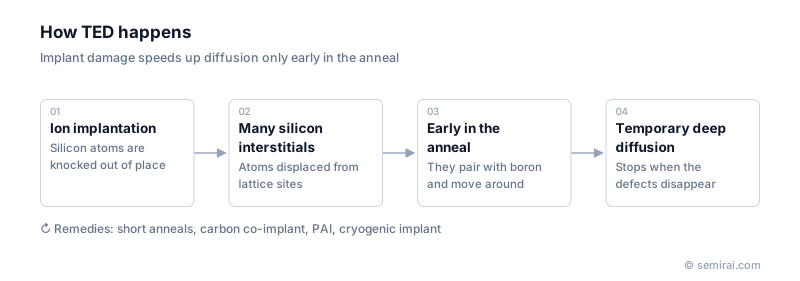
When implanted ions knock silicon atoms off their lattice sites, they leave large numbers of displaced atoms, called silicon interstitials. Once annealing begins, these interstitials pair with boron atoms and carry them through the crystal, raising the boron diffusion rate by orders of magnitude.
The extra interstitials gradually disappear. They first cluster into extended defects, such as rod-like {311} defects, which then dissolve, and the surplus is absorbed at the surface. When the excess is gone, diffusion returns to its normal rate. The total extra spreading depends on implant dose and energy and on the anneal conditions.
How it is suppressed
The basic approach is to finish the anneal before much diffusion can happen. Spike anneals raise the temperature for only an instant, and flash lamp and laser anneals heat only the surface for a millisecond or less, activating dopants while limiting their movement.
Implant engineering helps too. Carbon co-implantation captures interstitials before they can pair with boron. A pre-amorphization implant (PAI) changes how the damage forms and regrows. Cryogenic implantation, with the wafer cooled during the implant, produces a cleaner amorphous layer that leaves fewer interstitials behind.
FAQ
Why is boron the dopant most affected by TED?
Boron diffuses mainly by pairing with silicon interstitials, so an excess of interstitials speeds it up strongly. Boron is also light and implants deep, so shallow p-type junctions are already difficult, and TED makes them harder still.
Is TED a problem for arsenic?
Much less. Arsenic diffuses partly through vacancies, so excess interstitials have a smaller effect on it, and it diffuses slowly to begin with. Phosphorus, which also uses interstitials, does show significant TED.
Why does TED not continue for the whole anneal?
Because its fuel, the excess interstitials created by the implant, is limited. As they recombine, cluster and leave at the surface, their concentration falls back to equilibrium and the enhancement ends.
Comparisons
Related pages
- Pre-Amorphization Implant (PAI)
- Spike Anneal
- Lightly Doped Drain (LDD)
- Boron (B)
- Fick's Laws of Diffusion
- Cryogenic Ion Implantation
- Rapid thermal processing (RTP) equipment
- Kokusai Electric MARORA®
- Kokusai Electric TANDUO
- Koyo Thermo Systems (JTEKT Thermo Systems) RLA-1200
- Koyo Thermo Systems (JTEKT Thermo Systems) RLA-3100
Sources
Last updated: November 13, 2026