Barrier Metal (Diffusion Barrier)
A barrier metal is an ultra-thin metal layer formed around copper interconnects that stops copper from diffusing into the interlayer dielectric and the silicon below, and helps the copper adhere. Copper moves quickly through silicon and oxide and damages transistors, so the reliability of copper damascene wiring depends on this layer. The standard material is a TaN/Ta bilayer.
Also called: diffusion barrier, barrier layer, liner
Diagram
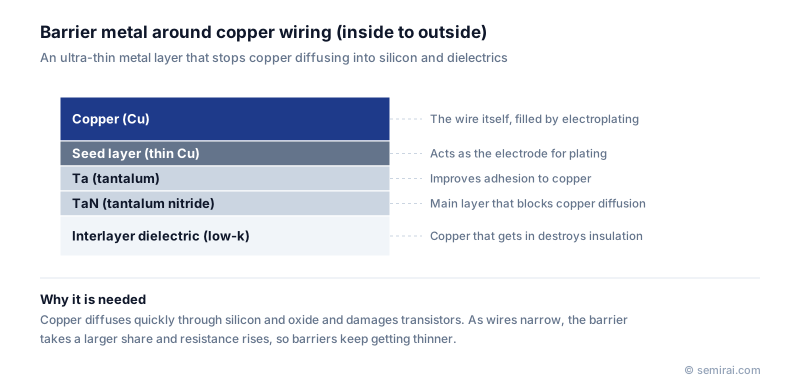
Why copper needs a barrier
Copper replaced aluminium as the main wiring metal because of its lower resistivity and better electromigration resistance, but it has a serious drawback: copper atoms diffuse readily through silicon dioxide and low-k dielectrics, especially under heat and electric field. Copper that reaches the dielectric causes leakage and breakdown between lines, and copper in silicon creates deep-level traps that increase junction leakage and degrade transistors.
The barrier therefore has to block copper completely, adhere well to both the dielectric and the copper, conduct electricity, and stay intact through later heating steps, all while being only a few nanometres thick.
The TaN/Ta stack in damascene wiring
In the damascene process, trenches and vias are etched into the dielectric, then lined with the barrier, a thin copper seed layer and finally electroplated copper, before CMP removes the excess. Tantalum nitride (TaN) next to the dielectric is the main diffusion barrier; tantalum (Ta) on top bonds well to copper and helps the seed layer wet the surface.
These layers are usually deposited by sputtering (PVD) with ionised metal flux to reach into vias. Titanium nitride is the usual barrier and adhesion layer for tungsten contacts and plugs rather than for copper.
Scaling: thinner barriers and new liners
The barrier has much higher resistivity than copper. As lines shrink to a few tens of nanometres wide, a barrier of fixed thickness takes up a growing share of the cross-section and line resistance rises sharply. Manufacturers have responded by thinning the barrier, adding cobalt or ruthenium liners that improve copper filling, and studying ALD barriers and self-forming barriers such as manganese-based layers.
For the narrowest lines, metals that need little or no barrier, such as ruthenium and molybdenum, are being researched as replacements for copper itself.
Japanese companies involved
- ULVAC makes sputtering (PVD) systems used to deposit metal films, including barrier and seed layers for interconnects.
- ULVAC · Vacuum deposition (sputtering) equipment and vacuum pumps
FAQ
Why is the barrier made of two layers?
No single material does every job well. TaN is an excellent diffusion barrier and adheres to the dielectric, but copper does not wet it well. A thin Ta layer on top gives good adhesion and a suitable surface for the copper seed, which matters for void-free plating and for electromigration life.
Does aluminium wiring need a barrier?
Aluminium diffuses far less into oxide, so it does not need the same diffusion barrier. Aluminium wiring did use Ti and TiN layers, but mainly for adhesion, to improve electromigration resistance and, on top of the aluminium, as an antireflective coating for lithography.
What is a barrierless interconnect?
It is wiring made of a metal that does not need a separate diffusion barrier, or needs only a very thin adhesion layer. Ruthenium and molybdenum are the main candidates, because their resistance increases less than copper's at very small dimensions.
Related pages
Sources
Last updated: November 2, 2026