BPSG / PSG (Borophosphosilicate Glass)
BPSG (borophosphosilicate glass) is silicon dioxide doped with a few percent each of boron and phosphorus; with phosphorus alone it is called PSG (phosphosilicate glass). Compared with undoped oxide (NSG), it softens at lower temperature, so a heat treatment makes it flow and smooth out surface steps.
Also called: borophosphosilicate glass, phosphosilicate glass, BPSG, PSG
Diagram
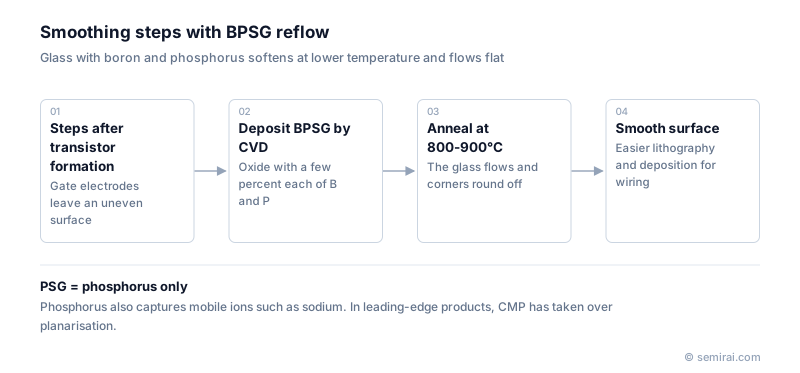
How BPSG reflow works
BPSG has been used as the pre-metal dielectric (PMD), the insulator deposited over the transistors before the first metal layer. It is deposited by atmospheric or sub-atmospheric CVD from TEOS and ozone with boron and phosphorus sources such as triethyl borate (TEB) and triethyl phosphate (TEPO). A heat treatment at about 800-900°C then makes the glass flow, rounding sharp steps over the gate electrodes. This step is called reflow.
Undoped oxide does not flow adequately even above 1000°C, and PSG also needs high temperatures; adding boron lowers the flow temperature. The phosphorus has a second benefit: it captures (getters) mobile ions such as sodium that would otherwise shift transistor threshold voltages.
Limits and current use
Boron and phosphorus contents are each typically a few weight percent. If they are too high, crystals can precipitate in the film and form defects, and the film absorbs moisture and changes over time, so the composition and storage time before reflow are controlled carefully.
Since the 1990s, chemical mechanical polishing (CMP) has taken over most of the planarisation role, and high-temperature reflow conflicts with shallow junctions because it spreads the dopants. BPSG and PSG are still used in some processes as PMD for their gap fill and gettering, often combined with lower-temperature films.
Japanese companies involved
- Tokyo Electron (TEL) · Coat/develop, etch and deposition equipment
- Kokusai Electric · Batch deposition, diffusion and ALD equipment
FAQ
What is the difference between BPSG and NSG?
NSG is undoped silicon glass with stable film properties but no flow at practical temperatures. BPSG adds boron and phosphorus so it can be reflowed to smooth steps and getters mobile ions, at the cost of needing control of moisture uptake and precipitation.
Why add boron as well as phosphorus?
Boron lowers the temperature at which the glass softens. PSG alone needs about 1000°C or more to flow, while BPSG flows at roughly 800-900°C, which limits the heat that reaches the transistor dopant profiles.
How are boron and phosphorus levels measured?
Common methods include X-ray fluorescence and Fourier-transform infrared spectroscopy, which detect the boron and phosphorus bonds in the film. They are used to keep the composition within the window that gives good flow without precipitation.
Related pages
- TEOS (Tetraethyl Orthosilicate)
- Interlayer Dielectric (ILD)
- Reflow Soldering
- Boron (B)
- Phosphorus (P)
- Oxide Film (Silicon Dioxide)
- Insulating Film (Dielectric Film)
- Planarisation (Planarization)
- CVD equipment
- Oxide CMP equipment
- Kokusai Electric QUIXACE®
- Kokusai Electric QUIXACE®-II
- Kokusai Electric QUIXACE ULTIMATE®
- Tokyo Electron (TEL) Episode™ 1
Sources
Last updated: November 13, 2026