Bottom Anti-Reflective Coating (BARC)
A bottom anti-reflective coating (BARC) is a thin film placed between the photoresist and the substrate to suppress light reflected from the substrate and its topography during exposure. Without it, reflected light interferes with incoming light inside the resist, forming standing waves that change line widths and reduce the focus margin.
Also called: BARC, anti-reflective coating, ARC
Diagram
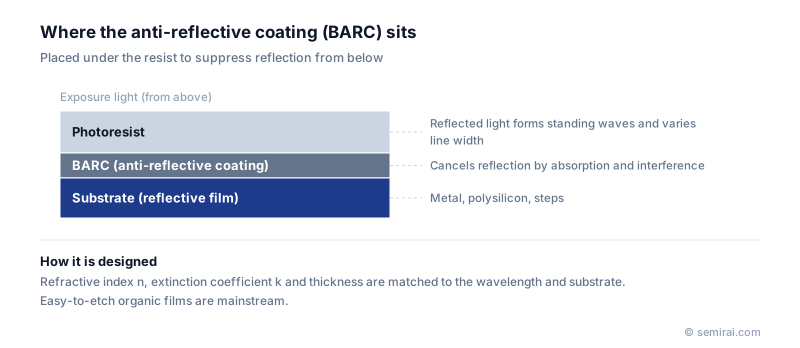
How a BARC works
A BARC reduces reflection in two ways. It absorbs light passing through it, and its thickness is chosen so that light reflected from its top and bottom surfaces cancels by interference. The design depends on the film's refractive index n and extinction coefficient k, on the exposure wavelength and on the optical properties of the resist and substrate.
Reflective substrates such as metals and polysilicon, and steps in the surface that scatter light sideways, cause the worst problems. A well-tuned BARC keeps critical dimensions consistent over different underlying films and topography.
Organic and inorganic BARCs
Organic BARCs are polymers spin-coated before the resist on the same coater/developer track. They are easy to apply and remove, and are the most common type. Inorganic anti-reflective layers, such as silicon oxynitride deposited by chemical vapour deposition, cover topography conformally and can double as part of a hard mask stack.
After lithography the BARC has to be opened by etching before the main layer is etched, so its etch rate and selectivity to the resist also matter. With EUV, substrate reflection is less of an issue, and underlayers are designed more for adhesion, pattern collapse and boosting resist sensitivity.
Japanese companies involved
- Nissan Chemical is a major supplier of anti-reflective coatings and other lithography underlayer materials.
- Tokyo Electron makes the coater/developer tracks that apply BARC and resist films in sequence.
- Tokyo Electron (TEL) · Coat/develop, etch and deposition equipment
FAQ
What is the difference between a BARC and a TARC?
A BARC sits under the resist and suppresses reflection from the substrate. A top anti-reflective coating (TARC) sits on the resist and reduces reflection at the air-resist interface. BARCs give the larger benefit and are far more widely used.
What is a standing wave in resist?
When reflected light overlaps incoming light, the intensity varies periodically through the resist thickness. This leaves ripples on the resist sidewall and makes line width depend on small changes in resist thickness.
Is BARC still needed with EUV?
Reflection is less critical, but an underlayer is still used. EUV underlayers are tuned for adhesion, preventing thin resist lines from collapsing, and contributing secondary electrons that improve the resist's response.
Related pages
Sources
Last updated: November 2, 2026