Total Reflection X-ray Fluorescence (TXRF)
Total reflection X-ray fluorescence (TXRF) is an analysis method that directs X-rays at a wafer at a very shallow angle so that they are totally reflected, then measures the fluorescent X-rays emitted by trace elements on the surface. In fabs it is the standard non-destructive way to measure metal contamination on wafer surfaces.
Also called: TXRF, VPD-TXRF, total reflection XRF
Diagram
Why total reflection helps
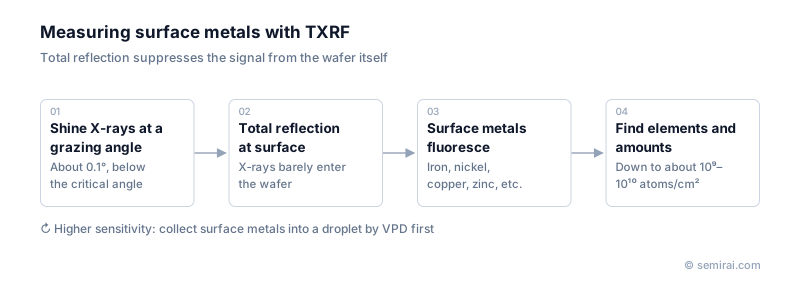
Below a critical angle, about a tenth of a degree for silicon at typical X-ray energies, the incident beam barely penetrates the wafer and is reflected from the surface. Because little X-ray energy reaches the bulk silicon, the background signal from the substrate is very small. Fluorescence from contaminants sitting on the surface, such as iron, nickel, copper and zinc, therefore stands out clearly.
The incident and reflected beams also overlap above the surface, so atoms there are excited twice. The result is detection limits around 10⁹ to 10¹⁰ atoms per square centimetre, depending on element and conditions, measured directly on a whole wafer at many points.
VPD-TXRF and why metals matter
For even lower limits, vapour phase decomposition (VPD) is used first. Hydrofluoric acid vapour dissolves the native oxide, a droplet is rolled across the wafer to collect the metals, and the dried residue is measured by TXRF. Concentrating the whole surface into one spot raises sensitivity by orders of magnitude, but the result is an average with no map.
Metal contamination degrades gate oxide reliability, increases junction leakage and shortens carrier lifetime. Fabs therefore run TXRF routinely after cleaning, when qualifying new or repaired tools, and to check chemicals, gases and parts that touch wafers.
Japanese companies involved
- Rigaku makes TXRF systems for semiconductor fabs, including models that combine TXRF with automated VPD sample preparation.
- Rigaku · X-ray metrology and thermal analysis
FAQ
Can TXRF detect light elements such as sodium or aluminium?
Sensitivity falls for light elements, whose low-energy fluorescence is absorbed easily, and some tools measure them only with special excitation conditions. Light metals are often checked with VPD followed by inductively coupled plasma mass spectrometry (ICP-MS) instead.
Is TXRF destructive?
Direct TXRF is not; the wafer can be measured and returned. VPD-TXRF dissolves the surface oxide and so is normally done on monitor wafers rather than product.
Related pages
Sources
Last updated: November 1, 2026