X-ray Absorption Near Edge Structure (XANES)
X-ray absorption near edge structure (XANES) is the detailed shape of an X-ray absorption spectrum close to an element's absorption edge, the energy at which a core electron can first be ejected. Analysing this shape reveals the chemical state, such as oxidation state, of a chosen element and the symmetry of the atoms around it.
Also called: XANES, NEXAFS, near-edge X-ray absorption fine structure
Diagram
How XANES works
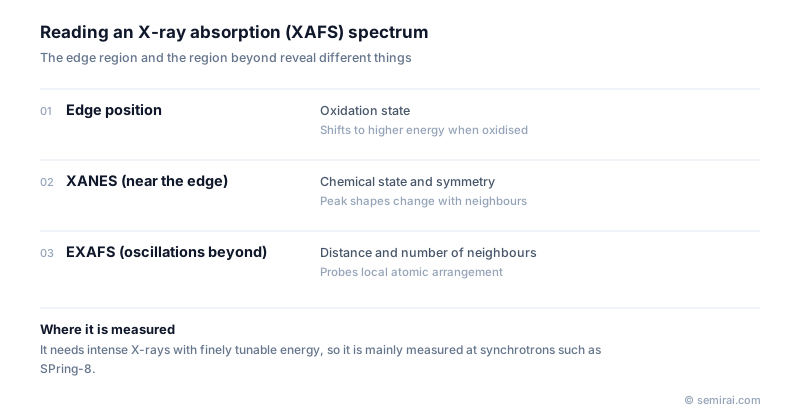
As the X-ray energy is scanned upward, absorption by a given element rises sharply once the photons can eject a core electron. The region from just below this edge to a few tens of electronvolts above it is XANES. When the element is oxidised the edge shifts to higher energy, and the peaks and dips just above it change with the arrangement of neighbouring atoms.
Further above the edge, the spectrum shows slow oscillations called EXAFS (extended X-ray absorption fine structure), which give distances to neighbouring atoms and their number. XANES and EXAFS together make up XAFS, X-ray absorption fine structure.
Measurement and uses in semiconductors
XANES needs an intense X-ray source whose energy can be tuned in fine steps, so most measurements are made at synchrotron facilities such as SPring-8 in Japan, although laboratory instruments exist for some elements. Because it does not require a crystal, it works on amorphous films and on dilute elements.
In semiconductor research it is used to study the state of hafnium and dopants in high-k gate dielectrics, oxidation at interfaces and the chemistry of new interconnect and memory materials. Detecting fluorescence rather than transmitted X-rays, or using grazing incidence, focuses the measurement on thin films and near-surface layers.
Japanese companies involved
- Rigaku makes X-ray analysis instruments, including laboratory XAFS systems that allow absorption measurements without a synchrotron.
- Japan's SPring-8 synchrotron offers XAFS beamlines that industrial users, including semiconductor and materials companies, use for XANES studies.
- Rigaku · X-ray metrology and thermal analysis
FAQ
How does XANES differ from XPS?
XPS measures the energy of electrons emitted from the top few nanometres, so it needs vacuum and sees only the surface. XANES measures X-ray absorption, and with fluorescence detection it can probe buried layers and interfaces, sometimes even in air or under gas.
Is XANES used in production?
Rarely. Synchrotron access, long measurement times and complex analysis make it a research and failure analysis method. Its findings guide process and material choices, which are then monitored in the fab with faster inline methods.
Related pages
- Chemical Shift (XPS)
- X-ray Fluorescence (XRF)
- High-k Dielectric
- Secondary Ion Mass Spectrometry (SIMS)
- Failure Analysis (FA)
- X-ray Photoelectron Spectroscopy (XPS)
- Failure analysis equipment
- Hamamatsu Photonics Dual PHEMOS®-X C16506-01
- Hamamatsu Photonics iPHEMOS®-DDX C18040-11
- Hamamatsu Photonics iPHEMOS-MPX C10506-07-06
- Hamamatsu Photonics PHEMOS-X emission microscope C15765-01
Sources
Last updated: November 13, 2026