Work in Process (WIP)
Work in process (WIP) means products that have been started on a production line but are not yet finished. In a semiconductor fab it is the total quantity of wafers somewhere between start and completion, counted in wafers or lots. In accounting it is a type of inventory, and much of a chipmaker's work-in-process inventory is partly processed wafers.
Also called: WIP, work in progress
Diagram
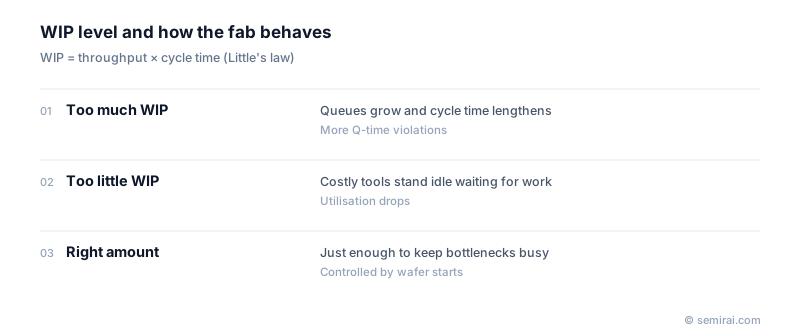
WIP, throughput and cycle time
Little's law links the three: WIP = throughput × cycle time. When throughput is limited by tool capacity, adding WIP does not increase output; wafers simply queue longer in front of tools, and cycle time grows. Too little WIP is also costly, because bottleneck tools run out of work and stand idle.
The aim is enough WIP to keep bottleneck tools busy and no more. Fabs control this mainly through the rate of wafer starts.
Managing WIP in the fab
The manufacturing execution system tracks where every lot is and how far it has progressed, and engineers watch WIP by step and tool group. A pile-up at one step, sometimes called a WIP bubble, starves the steps after it and then floods them later. Dispatching rules, which decide which lot runs next on each tool, are adjusted to smooth these waves.
Waiting WIP is held in stockers and buffers. Where a step has a queue-time limit, such as between cleaning and deposition, excessive WIP can turn into a yield problem, because lots that wait too long must be reworked or scrapped.
Japanese companies involved
- Daifuku and Murata Machinery supply the stockers and overhead transport that hold and move a fab's WIP.
- Daifuku · Cleanroom automated material handling systems (AMHS)
- Murata Machinery (Muratec) · Stockers and fab automation
FAQ
What does WIP stand for?
Work in process, also written work in progress. In everyday use WIP also means any unfinished piece of work, such as a draft or a design under development; in manufacturing it means unfinished products on the line.
Why is too much WIP a problem?
It lengthens cycle time without raising output, ties up money in unfinished inventory, slows the response to engineering changes and increases the risk of exceeding queue-time limits, which leads to rework or scrap.
Related pages
- Throughput
- Manufacturing Execution System (MES)
- Stocker (Automated Wafer Storage)
- FOUP (Front Opening Unified Pod)
- Equipment Availability and Utilization
- Overall Equipment Effectiveness (OEE)
- Automated material handling systems (AMHS)
- Murata Machinery (Muratec) HTC
- Murata Machinery (Muratec) MDS
- Murata Machinery (Muratec) SRC350X
- Murata Machinery (Muratec) SRC600
Sources
Last updated: November 13, 2026