Gas Cabinet
A gas cabinet, or cylinder cabinet, is a ventilated steel enclosure that holds cylinders of toxic, flammable or corrosive specialty gases and supplies them safely to process tools. It is used for gases such as silane, arsine, phosphine, chlorine and nitrogen trifluoride, where a leak could endanger people and equipment.
Also called: cylinder cabinet, specialty gas cabinet
Diagram
What is inside
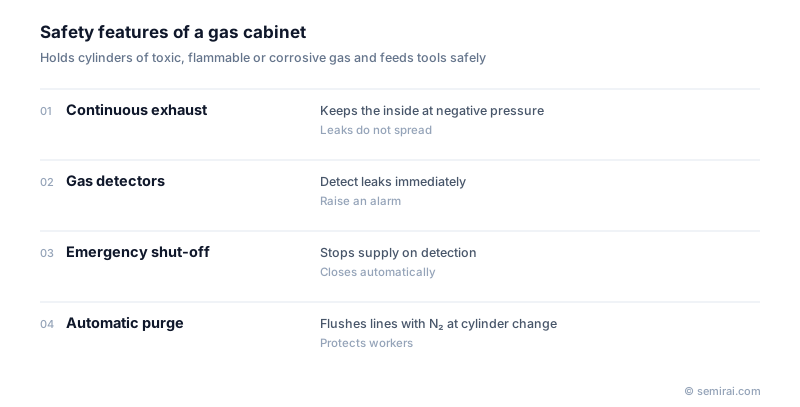
The cabinet contains the gas cylinder, a pressure regulator, shut-off valves, purge equipment for flushing lines with inert gas, pressure gauges and filters, all on a compact gas panel. It is connected to an exhaust duct and kept at negative pressure, so any leaked gas is drawn away rather than escaping into the room.
Gas detectors monitor the cabinet and its surroundings. When a leak is detected, an emergency shut-off valve closes automatically and an alarm sounds. Many cabinets also shut down on seismic detection.
Cylinder changes and distribution
Changing a cylinder is the riskiest routine task. The controller first purges the lines with nitrogen to remove the hazardous gas, then the old cylinder is removed, the new one connected, the joint leak-checked and the lines purged again before supply resumes. Purging also keeps air and moisture out, which would reduce gas purity and cause defects.
From the cabinet, gas travels through piping to a valve manifold box (VMB), which splits it to several tools. Bulk gases such as nitrogen come from tanks or on-site generators, but specialty gases are handled cylinder by cylinder, so the gas cabinet is where their supply begins. Installation follows local high-pressure gas regulations and SEMI S2 and related guidelines.
Japanese companies involved
- Taiyo Nippon Sanso supplies specialty gases and gas supply systems for semiconductor fabs.
- Fujikin makes valves and integrated gas system components used in gas cabinets and tool gas panels.
- Taiyo Nippon Sanso · Specialty gases, gas supply systems and MOCVD equipment
- Fujikin · Gas flow controllers and integrated gas systems
FAQ
Why is a gas cabinet kept at negative pressure?
Continuous exhaust keeps air flowing into the cabinet and out to treatment. If a fitting leaks, the gas is captured by the exhaust instead of spreading into the subfab or cleanroom, giving time for detectors and shut-off valves to act.
What is a VMB?
A valve manifold box takes gas from one supply line and divides it among several tools, each with its own valves. It is usually also ventilated and monitored, so that each branch can be isolated for maintenance without stopping the others.
Related pages
Sources
Last updated: November 12, 2026