BHF (Buffered Hydrofluoric Acid)
BHF (buffered hydrofluoric acid), also called BOE (buffered oxide etch), is a mixture of hydrofluoric acid (HF) and ammonium fluoride (NH₄F) used to wet-etch silicon oxide (SiO₂). The ammonium fluoride acts as a buffer that keeps the acidity and the active fluoride species steady, so the etch rate stays stable over long use.
Also called: BOE, buffered oxide etch, buffered HF
Diagram
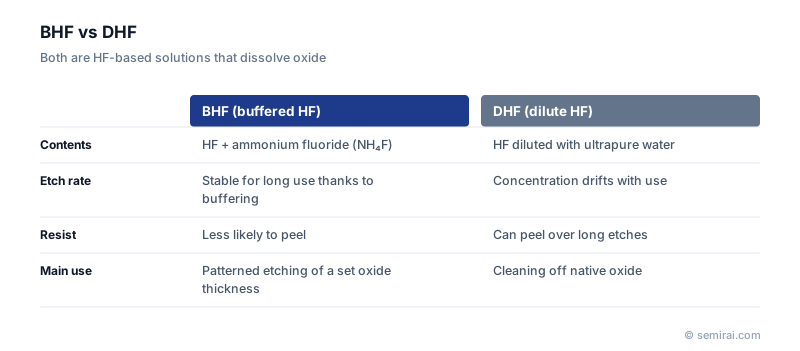
Why buffering matters
In dilute HF (DHF), the fluoride species are consumed as oxide dissolves, so the etch rate drifts. In BHF the ammonium fluoride replenishes what is used, so the rate stays nearly constant even after many wafers. This makes BHF suitable for removing a defined thickness of a thick oxide.
The milder acidity also means photoresist masks are less likely to lift during etching. Common mixtures are expressed as the ratio of ammonium fluoride solution to HF, such as 6:1 or 10:1, and the etch rate depends on the ratio and the temperature.
Selectivity and uses
BHF dissolves oxide readily but barely attacks silicon and etches silicon nitride only slowly, so oxide can be removed while leaving the underlying layers. It is used to open contacts in oxide, to release sacrificial oxide in MEMS, and in compound semiconductor device processing, where dry etching might damage the surface below.
Ammonium fluoride can crystallise out at low temperature, so the bath temperature is controlled. Some products include a surfactant so the liquid wets fine patterns.
Japanese companies involved
- Stella Chemifa produces high-purity buffered hydrofluoric acid for semiconductor wet processing.
- Kanto Chemical and Mitsubishi Gas Chemical supply high-purity etching and cleaning chemicals.
- Stella Chemifa · High-purity hydrofluoric acid and fluorine chemicals
- Kanto Chemical · High-purity process chemicals for cleaning, etching and CMP
- Mitsubishi Gas Chemical · High-purity hydrogen peroxide and cleaning chemicals
FAQ
What is the difference between BHF and DHF?
DHF is HF diluted with water, used mainly in cleaning to strip native oxide. BHF adds ammonium fluoride as a buffer, so its etch rate stays constant for longer and it is gentler on resist, which suits patterned etching of thicker oxide.
Does BHF etch silicon or nitride?
Silicon is hardly etched, and silicon nitride is etched far more slowly than oxide. That selectivity lets BHF remove oxide while keeping the silicon or nitride underneath.
Related pages
Sources
Last updated: November 2, 2026