Copper Recess (for Hybrid Bonding)
Copper recess is the condition, or the amount, by which the copper pads on a bonding surface sit slightly below the surrounding dielectric, typically by a few nanometres, before hybrid bonding. Hybrid bonding joins two flat surfaces with mixed copper pads and dielectric so that copper bonds to copper and dielectric to dielectric at once, and this small recess largely decides whether the bond succeeds.
Also called: Cu recess, pad recess
Diagram
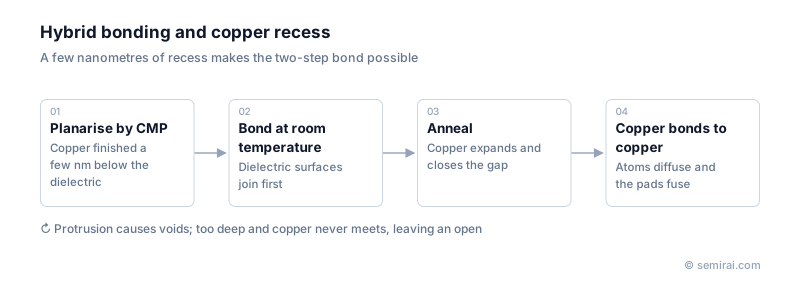
How the two-step bond works
First the two surfaces are brought together at room temperature, and the flat dielectric surfaces stick by molecular forces. Because the copper is recessed, a small gap remains between opposing pads.
Then the stack is annealed. Copper has a larger coefficient of thermal expansion than the dielectric, so it expands more, closes the gap and presses against the opposite pad, and atoms diffuse across the interface to join the two pads. If the copper protrudes instead, it touches first, holds the dielectric surfaces apart, and leaves voids.
Controlling the recess
If the recess is too deep, the copper cannot reach the opposite pad even after expansion, and the connection is open. The recess depends on CMP conditions, the removal rate ratio between copper and dielectric, pad size and pattern density, so it must be held within a few nanometres across the whole wafer.
Surface height is measured with atomic force microscopy (AFM) and similar methods. As the bond pitch shrinks, the allowed window narrows further.
Japanese companies involved
- Ebara builds CMP systems used to prepare bonding surfaces.
- Tokyo Electron makes wafer bonding equipment used in hybrid bonding processes.
- Ebara · CMP systems, dry vacuum pumps and exhaust treatment
- Tokyo Electron (TEL) · Coat/develop, etch and deposition equipment
FAQ
Why must the copper be recessed rather than flush?
If copper stands above the dielectric, the pads touch first and keep the dielectric surfaces from bonding, leaving gaps. A slight recess lets the dielectric bond first at room temperature, and the anneal then expands the copper to close the gap and form the metal bond.
How is copper recess different from dishing?
Both leave copper below the surrounding surface. Dishing is an unintended defect in which the centre of a wide copper feature is over-polished into a dish shape. Copper recess is a deliberate, targeted depth for hybrid bonding, and being either too shallow or too deep causes failures.
Related pages
Sources
Last updated: November 13, 2026