Diborane (B2H6)
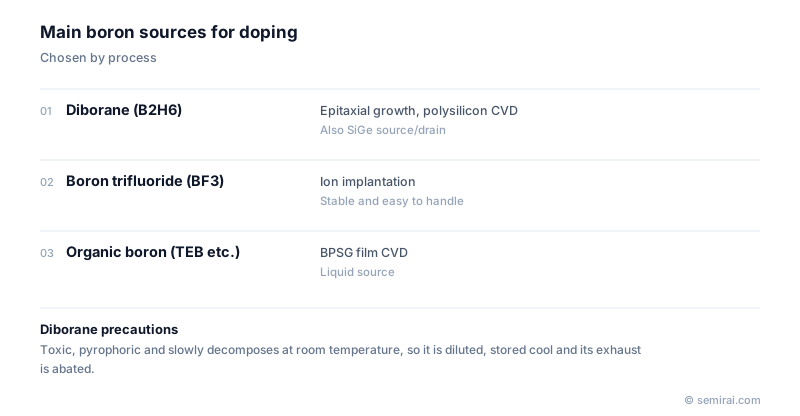
Diborane (B2H6) is a colourless gas made of two boron atoms and six hydrogen atoms. It is a source gas for adding boron to semiconductors to make them p-type. It is used when boron is built into a film during growth, in silicon and SiGe epitaxy, polysilicon CVD and plasma doping.
Also called: B2H6
Diagram
Role in advanced transistors
In leading-edge logic, the source and drain regions of pMOS transistors are formed from SiGe heavily doped with boron and grown epitaxially. The SiGe compresses the channel and boosts hole mobility, while the boron makes the regions highly conductive. Diborane is the usual boron source for this growth, so it is essential to advanced CMOS.
Diborane is also used for boron-doped polysilicon and for boron-doped epitaxial silicon layers, where the dopant has to be built in evenly as the film grows.
Instability and handling
Diborane is toxic and can ignite spontaneously in air. It is also unstable: even at room temperature it slowly decomposes into heavier boron hydrides and hydrogen, so its concentration changes over time. To slow this down, it is supplied as a dilute mixture in hydrogen or nitrogen and stored cool.
Like other hazardous specialty gases, diborane is used in gas cabinets with detectors and shut-off valves, and tool exhaust is treated in abatement systems. Other boron sources are chosen where they are easier to use: boron trifluoride (BF3) for ion implantation, and liquid organic boron sources such as triethyl borate (TEB) for BPSG film deposition.
Japanese companies involved
- Taiyo Nippon Sanso supplies specialty gases and gas supply systems to semiconductor fabs.
- Taiyo Nippon Sanso · Specialty gases, gas supply systems and MOCVD equipment
FAQ
Why is diborane used diluted?
Pure diborane slowly decomposes at room temperature, changing its concentration and forming heavier boranes. Dilution in hydrogen or another gas slows this and makes handling safer. Doping needs only tiny amounts of boron, so a dilute mixture is perfectly adequate.
Why is BF3 rather than diborane used for implantation?
BF3 is stable and easy to ionise, and the BF2+ ion it produces is heavy, which helps make very shallow boron implants. Diborane's instability and toxicity offer no advantage in an ion source, so it is reserved for growth processes where boron is incorporated directly.
Related pages
Sources
Last updated: November 13, 2026