Hydrogen Bromide (HBr)
Hydrogen bromide (HBr) is a colourless gas of hydrogen and bromine. In semiconductor manufacturing it is used to etch silicon and polysilicon precisely by dry etching. It is especially important for patterning polysilicon gate electrodes and for etching the shallow trenches of shallow trench isolation (STI), often mixed with chlorine (Cl2) and oxygen.
Also called: HBr
Diagram
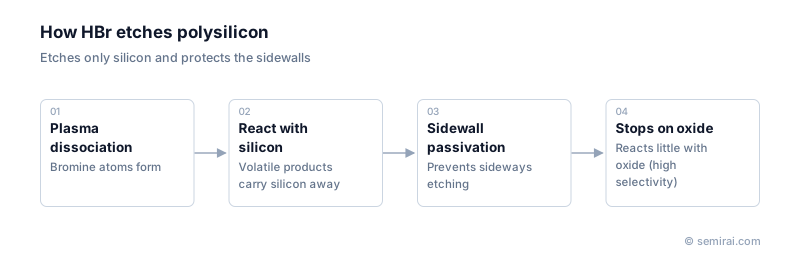
Why HBr is used for silicon etching
HBr has two useful properties. First, it etches silicon while hardly etching the oxide underneath, giving high selectivity. In the plasma, bromine atoms from HBr react with silicon but react poorly with silicon dioxide, so the etch can stop on a very thin gate oxide without punching through.
Second, it produces vertical sidewalls. Some of the silicon-bromine reaction products, together with oxygen, deposit on the sidewalls as a thin protective layer. This layer prevents sideways etching, so the pattern keeps its width from top to bottom.
Handling
HBr reacts with moisture in the air to form hydrobromic acid, a strong acid. It is therefore highly corrosive and easily damages piping and tool parts. It is handled in thoroughly dried lines, with leak detection and abatement equipment.
Unlike perfluorocarbons, HBr is not a significant greenhouse gas, which is one reason halogen chemistries such as HBr and chlorine are attractive for silicon etching compared with fluorine-carbon gases.
Japanese companies involved
- Taiyo Nippon Sanso supplies specialty gases and gas supply systems to semiconductor fabs.
- Taiyo Nippon Sanso · Specialty gases, gas supply systems and MOCVD equipment
FAQ
How do HBr and chlorine etching differ?
Both etch silicon. HBr etches oxide less and gives higher selectivity, while chlorine etches faster with somewhat lower selectivity. Real processes mix the two or switch between them during an etch, for example using chlorine for the bulk and HBr near the oxide.
What precautions does HBr need?
HBr forms hydrobromic acid with moisture and corrodes metal lines and parts, so lines are purged dry before use. Leak detectors and automatic shut-off valves are installed, and because the gas irritates the eyes and airways, exhaust is treated in abatement systems.
Related pages
Sources
Last updated: November 13, 2026