Die Attach Film (DAF)
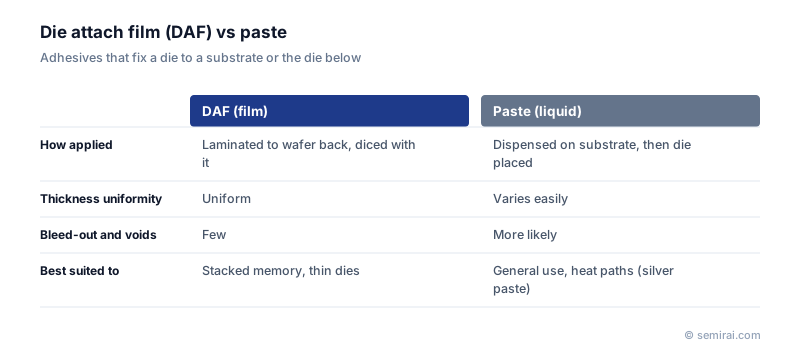
Die attach film (DAF) is a thin adhesive film used for die bonding instead of liquid paste. It is laminated to the back of the wafer before dicing, so every die comes off the tape with a uniform layer of adhesive already attached and can be placed directly on a substrate or on another die.
Also called: DAF, dicing die attach film (DDAF), film over wire (FOW)
Diagram
Why film instead of paste
Paste is dispensed or printed onto the substrate, so its thickness varies and it can squeeze out around the die (bleed-out) or trap voids. A film has a fixed, uniform thickness and does not flow beyond the die edge. This matters most when dies are stacked: in memory packages with many dies, small differences in each layer add up to tilt, uneven height and warpage of the whole stack.
DAF also allows very thin bond lines, which keeps packages thin, and it can be supplied combined with dicing tape so that one lamination step prepares the wafer for both dicing and die bonding.
Material and process
DAF is typically an epoxy-based resin with filler, supplied in a partly cured (B-stage) state. When the die is placed with heat and pressure, the film softens, wets the surface and then cures to form the bond. Some films are designed to flow around wire bonds of the die below, so that a die of the same size can be stacked directly on top.
Separating the film with the die is a challenge. With blade dicing the soft film can leave burrs, and with dicing before grinding or stealth dicing the film is cut separately, for example by laser or by cooling and expanding the tape so that it breaks cleanly at the die edges.
Japanese companies involved
- Resonac is a major supplier of die attach films, used especially for stacked memory packages.
- DISCO offers laser processes for cutting the film after dicing before grinding, as part of its thin-wafer dicing solutions.
FAQ
When is paste still preferred over DAF?
Paste is cheaper and flexible for many products, and silver-filled pastes give the thermal and electrical conductivity that most films cannot. Single-die packages with moderate requirements often still use paste.
Why is DAF important for 3D NAND packages?
Memory cards and SSD packages stack many thin NAND dies. Uniform, thin film adhesive keeps the stack level and thin and avoids voids and bleed-out between layers, which liquid paste cannot reliably do.
Related pages
Sources
Last updated: November 13, 2026