Lead On Chip (LOC)
Lead on chip (LOC) is a package structure in which the leads of a leadframe extend over the top surface of the chip and are attached to it directly with insulating adhesive tape. Because no die pad is needed, a larger chip fits inside a package of fixed outline, which made LOC common for DRAM in the 1990s.
Also called: LOC package
Diagram
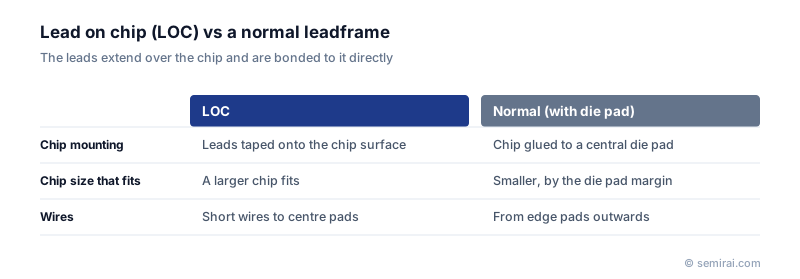
How LOC differs from a normal leadframe
In a conventional leadframe package the chip sits on a central metal platform, the die pad, and the leads are arranged around it. Gold wires bridge the gap from the pads on the chip edge to the lead tips. Everything must fit inside the moulded body, so the die pad and the ring of leads around it limit how large the chip can be.
LOC removes the die pad. The inner leads are extended inwards so that they lie on top of the chip, separated from it by a layer of adhesive tape, typically polyimide-based, which both insulates and holds the chip in place. The leads now overlap the silicon instead of surrounding it.
Why DRAM adopted it
Each DRAM generation brought a larger die, but the outlines of the standard memory packages of the time, such as SOJ and TSOP, were fixed by industry standards. With a die pad and peripheral leads there was simply no room left around the chip. Placing the leads over the chip solved this and let a bigger die go into the same outline.
DRAM designs also tended to place the bond pads in a single row down the centre of the chip. With LOC, the lead tips arrive right next to that row, so the bond wires can be very short.
Limitations and what replaced it
Leads lying across the active surface add parasitic capacitance, and the adhesive tape can absorb moisture and introduce stress, so both had to be managed for reliability. As DRAM moved to substrate-based packages such as BGA and FBGA, LOC fell out of use for memory, but it is still cited alongside chip on lead (COL) as a way to fit a large die into a leadframe package.
Japanese companies involved
- Mitsui High-tec and Shinko Electric Industries manufacture leadframes, the stamped or etched metal frames on which leaded packages such as LOC types are built.
- Shinko Electric Industries · FC-BGA package substrates and lead frames
- Mitsui High-tec · Lead frames
FAQ
What is the difference between LOC and COL?
In lead on chip the leads are bonded on top of the chip. In chip on lead the chip is mounted on top of the leads, so they run underneath it. Both eliminate the die pad so that a larger die fits into a fixed package outline.
Is LOC still used today?
Much less than before. Most DRAM now ships in ball grid array packages built on organic substrates, which offer more connections and better electrical performance. LOC survives mainly in older or cost-driven leadframe products.
Related pages
Sources
Last updated: November 2, 2026