Curing
Curing is the process of hardening a liquid or paste resin by applying heat or ultraviolet light, which links its molecules together (cross-linking). In semiconductor manufacturing it is applied to many resins, including mould compounds, underfills, die-attach pastes and films, and polyimide protective layers.
Also called: cure, post-mould cure, PMC
Diagram
Post-mould cure
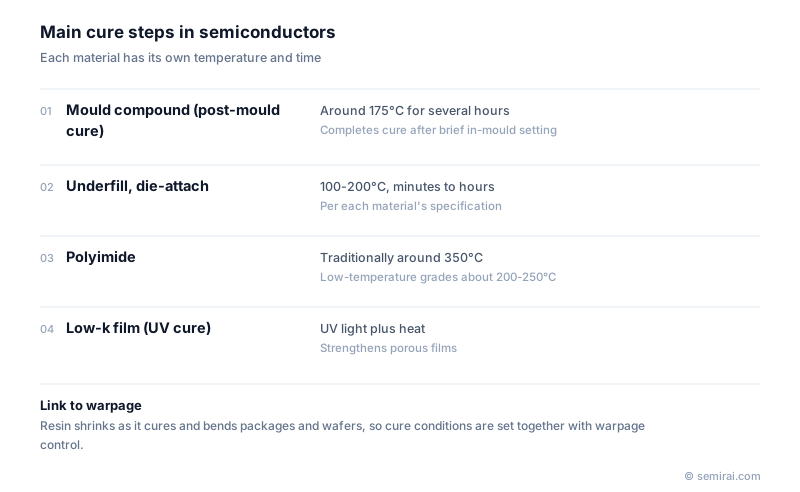
The best-known example is the post-mould cure (PMC). In transfer moulding, the compound is held in the mould for only a few minutes before the packages are ejected, to keep throughput high. At that point it is not fully cured, so the moulded strips are baked again, typically at around 175°C for several hours, to complete the reaction.
Incomplete cure leaves the resin weaker and more prone to moisture uptake, which shows up as failures in reliability tests. Underfill and die-attach materials are likewise cured at specified temperatures and times.
Polyimide, low-k films and warpage
For polyimide used as a protective layer or as the dielectric of redistribution layers, curing drives off solvent and closes the molecular rings (imidisation). Traditional polyimides need around 350°C, but low-temperature grades that cure at about 200-250°C are used with heat-sensitive structures such as fan-out packages.
Resin shrinks as it cures, which bends wafers and packages, so cure conditions are set together with warpage control. In front-end processing, UV curing is used to strengthen porous low-k dielectric films.
Japanese companies involved
- Sumitomo Bakelite and Resonac make epoxy mould compounds whose cure behaviour sets moulding and post-mould cure conditions.
- Namics supplies underfills and die-attach materials, each specified with its own cure profile.
- Sumitomo Bakelite · Epoxy mold compounds and package materials
- Resonac · CMP slurries, packaging materials and SiC epitaxial wafers
- Namics · Underfill and die attach materials
FAQ
How is the degree of cure checked?
A common method is differential scanning calorimetry (DSC), which measures the heat released by any remaining reaction; less residual heat means a more complete cure. The glass transition temperature, which rises with cure, is another indicator.
Can a resin be over-cured?
Yes. Excessive temperature or time can degrade the resin, making it brittle, discoloured or poorly adhering. Cure profiles specify both minimum and maximum conditions.
Related pages
Sources
Last updated: November 13, 2026