Die Bonding (Die Attach)
Die bonding, also called die attach, is the back-end step that fixes each die cut from a wafer at its position on a lead frame, substrate or another wafer. A machine called a die bonder picks the die off the dicing tape with a vacuum collet, aligns it and places it on the bonding material.
Also called: die attach, die mounting, chip bonding
Diagram
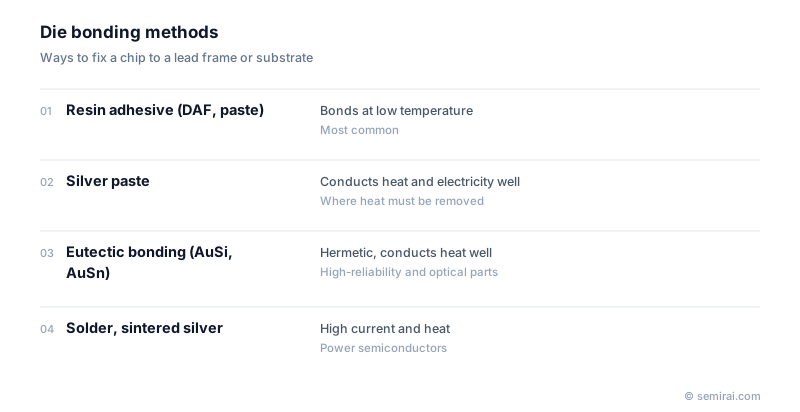
Bonding materials
The choice of material depends on what the joint must do. Epoxy adhesives, applied as paste or as die attach film laminated to the wafer back, are the most common and cure at low temperature. Silver-filled pastes conduct heat and electricity better and are used where the die backside must be grounded or cooled. Eutectic bonding with gold-silicon or gold-tin forms a strong, hermetic, highly conductive metal joint for high-reliability and optical devices.
Power semiconductors, which carry large currents and get hot, use solder or sintered silver. In advanced packaging, die bonding merges with interconnection: thermocompression bonding and hybrid bonding place the die and make all its electrical connections in one step.
Accuracy and speed
A conventional die bonder places thousands of dies per hour with an accuracy of tens of micrometres, which is enough for wire-bonded packages. Advanced packaging needs much more. Flip-chip and thermocompression bonders work at a few micrometres, and hybrid bonders for die-to-wafer stacking target accuracy below one micrometre while keeping the die surface free of particles.
Stacked memory, such as 3D NAND packages and HBM, requires many dies to be placed on top of one another, so accuracy, throughput and control of bonding force and temperature all have to improve together.
Japanese companies involved
- Shinkawa (Yamaha Robotics) and Toray Engineering make die bonders and flip-chip bonders, and Canon Machinery also builds die bonders.
- Namics and Resonac supply die attach pastes and films.
- Toray Engineering · Flip-chip bonders, die bonders and visual inspection systems
- Namics · Underfill and die attach materials
- Resonac · CMP slurries, packaging materials and SiC epitaxial wafers
- Shinkawa (Yamaha Robotics) · Wire bonders and die bonders
FAQ
What is the difference between die bonding and wire bonding?
Die bonding fixes the die mechanically (and sometimes thermally and electrically through its backside) to the package. Wire bonding then makes the electrical connections from the pads on top of the die to the package leads. They are separate steps on separate machines.
What is a known-good die?
A die that has been tested and found to work before it is bonded. Using only known-good dies matters most in multi-die packages, because one bad die can scrap a package containing several expensive good ones.
Related pages
Sources
Last updated: November 13, 2026