Flexural Strength
Flexural strength is the stress a plate or bar can withstand when bent before it breaks. In semiconductor manufacturing it is used to express how resistant a diced chip is to cracking, often called die strength, and it is given in megapascals (MPa).
Also called: die strength, bending strength, chip strength
Diagram
How it is measured
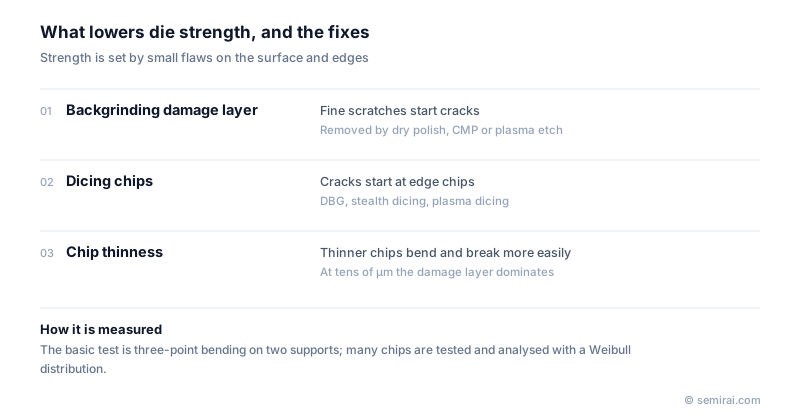
The basic method is the three-point bend test: the chip rests on two supports and is pushed down at the centre until it breaks, and the strength is calculated from the breaking force. The four-point bend test uses two loading points, and in ring-on-ring or ball-on-ring tests the chip rests on a ring and is loaded from above.
Silicon is brittle, so its strength is decided by the small flaws on its surface and edges, such as grinding scratches and dicing chips. Results scatter widely even under identical conditions, so many chips are tested and analysed statistically with a Weibull distribution.
Keeping thin chips strong
When chips are thinned to a few tens of micrometres, as in smartphones and stacked memory, the damaged layer left by backgrinding has a large effect and the chips break more easily. Stress relief removes this layer after grinding by dry polishing, CMP or plasma etching, restoring strength.
Edge chipping from dicing also lowers strength. Dicing before grinding (DBG), which cuts grooves first and then grinds until the chips separate, and stealth dicing, which forms a modified layer inside the silicon with a laser, are used to reduce it.
Japanese companies involved
- DISCO and Tokyo Seimitsu (ACCRETECH) make the grinders, polishers and dicing machines whose processes largely determine die strength.
- Okamoto Machine Tool Works builds wafer grinders and polishers used for thinning and stress relief.
- DISCO · Dicing, grinding and polishing equipment
- Tokyo Seimitsu (ACCRETECH) · Wafer probers, dicing and grinding machines, metrology
- Okamoto Machine Tool Works · Wafer polishers and grinders
FAQ
Why does chip strength vary so much?
Fracture in brittle silicon starts from the largest flaw under tension, and flaw size and location differ from chip to chip. That is why strength is reported as a statistical distribution rather than a single number.
Is the front or back side of a chip weaker?
Often the back side, because grinding leaves scratches and subsurface damage there, and the chip edges, because of dicing chips. Tests are set up so that the side of interest is in tension, which shows how well each process has been optimised.
Related pages
Sources
Last updated: November 13, 2026