FR-4
FR-4 is the grade name for a flame-retardant laminate made of woven glass-fibre cloth impregnated with epoxy resin, and it is the most widely used printed circuit board material. FR stands for flame retardant, and the designation comes from a grading system of the US National Electrical Manufacturers Association (NEMA).
Also called: glass-epoxy, FR4
Diagram
Typical properties
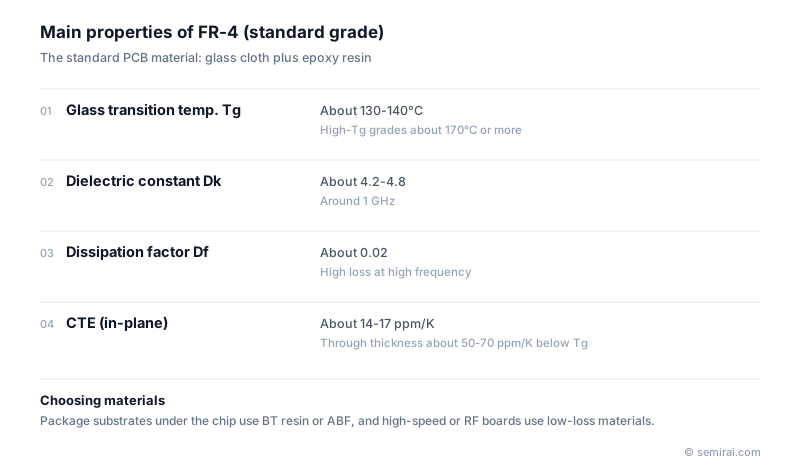
Standard FR-4 has a glass transition temperature (Tg) of about 130-140°C, a dielectric constant (Dk) of about 4.2-4.8 and a dissipation factor (Df) of about 0.02. Its in-plane coefficient of thermal expansion is about 14-17 ppm/K, while through the thickness it is much larger below Tg and larger still above it. Exact values vary by manufacturer and product.
Lead-free reflow runs hotter than tin-lead soldering, so high-Tg grades with a Tg of around 170°C or more, and halogen-free grades that achieve flame retardancy without halogen compounds, are now widely used.
Where FR-4 is and is not used
FR-4 is the material of the motherboard on which finished packages are mounted. The package substrate directly under the chip needs better dimensional stability and finer wiring, so it uses BT resin cores and build-up films such as ABF instead.
For 5G radio, millimetre-wave and fast server links, the dissipation factor of FR-4 causes too much signal loss, so low-Dk, low-Df materials based on fluoropolymers or modified polyphenylene ether replace it on the critical layers.
Japanese companies involved
- Mitsubishi Gas Chemical and Resonac produce FR-4 and higher-performance laminates, and Sumitomo Bakelite makes epoxy copper clad laminates for printed wiring boards.
- For package substrates, Ajinomoto supplies ABF build-up film, which takes over from FR-4-type materials directly beneath the chip.
- Sumitomo Bakelite · Epoxy mold compounds and package materials
- Ajinomoto · ABF insulating film for package substrates
- Resonac · CMP slurries, packaging materials and SiC epitaxial wafers
- Panasonic Connect · Plasma dicing, dry etching, plasma cleaning and flip chip bonding equipment
- Mitsubishi Gas Chemical · High-purity hydrogen peroxide and cleaning chemicals
FAQ
What do other FR grades mean?
The NEMA system covers several laminate grades. FR-1 and FR-2 are paper reinforced with phenolic resin, cheap and used for simple single-sided boards. FR-4 uses glass cloth and epoxy and offers much better strength and electrical properties.
Why is FR-4 not used at high frequencies?
Its dissipation factor of about 0.02 means a noticeable fraction of signal energy is absorbed as heat, and the loss grows with frequency. Its dielectric constant also varies with frequency and with the glass weave, which disturbs impedance on fast lines.
Related pages
- Printed Circuit Board (PCB)
- Copper Clad Laminate (CCL)
- Coefficient of Thermal Expansion (CTE)
- Package Substrate
- ABF (Ajinomoto Build-up Film)
- Through Hole
- Surface Mount Technology (SMT)
- Solder Resist
- Package substrates (FC-BGA)
- Ajinomoto ABF GL-102
- Ajinomoto ABF GX-92
- IBIDEN FC-BGA substrates
- Kyocera FC-BGA substrates
Sources
Last updated: November 13, 2026