Final Polishing
Final polishing is the last polishing step in silicon wafer manufacturing, which finishes the surface to an atomically smooth mirror. After double-side polishing (DSP) has set the thickness and flatness, final polishing removes less than 1 µm from the front surface only, taking away fine roughness (microroughness) and the faint light scattering known as haze.
Also called: final polish, finish polishing
Diagram
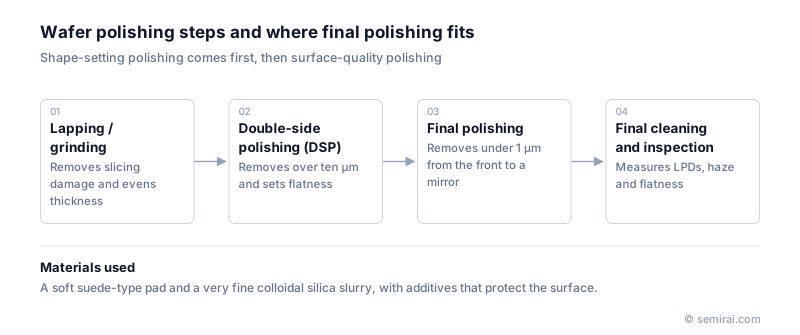
How final polishing differs from stock polishing
Earlier polishing removes material in bulk to set the wafer's shape: double-side polishing takes off more than ten micrometres from both faces at once. Final polishing is about surface quality rather than quantity. It reduces roughness to about 0.1 nm.
It uses a soft, suede-type polishing pad and a slurry of very fine colloidal silica. Additives in the slurry, such as water-soluble polymers, protect the surface and help lower roughness, and play an important part in the result.
How the result is judged
The quality of final polishing is judged by the number of defects counted as light point defects (LPDs) by surface inspection tools, and by the haze level. Wafers for the most advanced logic and memory are specified down to defects only a few tens of nanometres in size.
Together with the cleaning that follows, final polishing is one of the steps that most distinguish one wafer maker's quality from another's.
Japanese companies involved
- SUMCO and Shin-Etsu Chemical perform final polishing in their silicon wafer production.
- Fujimi Incorporated makes polishing slurries for silicon wafers, and Okamoto Machine Tool Works makes wafer polishing and grinding machines.
- Fujimi Incorporated · CMP slurries and polishing materials
- Okamoto Machine Tool Works · Wafer polishers and grinders
- SUMCO · Silicon wafers
- Shin-Etsu Chemical · Silicon wafers, photoresists and photomask blanks
FAQ
Why not do all the polishing with the fine final slurry?
It would be far too slow. The fine, gentle process removes very little material per minute. Coarser stock polishing removes damage and sets flatness efficiently, and final polishing only has to perfect the top surface.
Why does haze matter after final polishing?
High haze raises the background signal in surface inspection, so small particles and defects become harder to detect. It also reflects roughness that can degrade the gate oxide grown later, so haze is kept as low as possible.
Is final polishing the same as CMP?
Both are chemical mechanical polishing processes, but final polishing is done by the wafer maker on a bare silicon wafer. CMP in a fab planarises deposited films such as oxide and copper on patterned wafers, with different slurries and pads.
Related pages
- Microroughness
- Colloidal Silica
- Light Point Defect (LPD)
- Silicon Wafer Manufacturing
- Polishing Pad (CMP Pad)
- Nanotopography
- Wafer polishing and edge grinding equipment
- Okamoto Machine Tool Works PNX1200/PNX1200S
- Okamoto Machine Tool Works PNX332B
- Okamoto Machine Tool Works SPL series
- Okamoto Machine Tool Works SPP600S
Sources
Last updated: November 13, 2026