Float Zone Process (FZ Method)
The float zone process (FZ method) grows single-crystal silicon without a crucible. A narrow molten zone is created in a vertical polysilicon rod by a radio-frequency induction coil and moved slowly along the rod, so the silicon recrystallises as a single crystal while impurities are swept toward one end.
Also called: FZ method, floating zone method, zone melting
Diagram
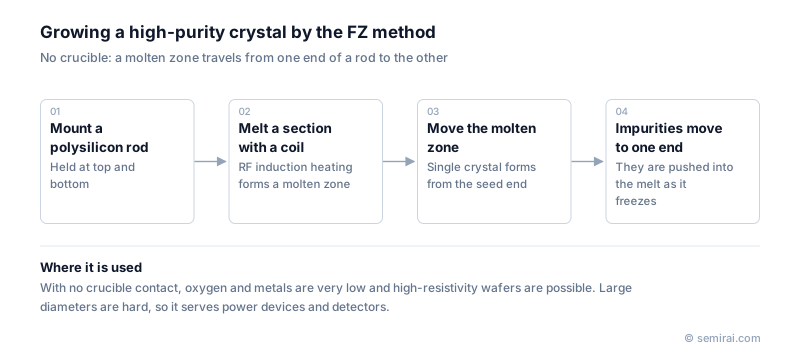
How the molten zone works
The polysilicon rod is held at its top and bottom ends. An induction coil heats a short section until it melts; surface tension and the electromagnetic field hold the molten zone in place between the two solid parts. A seed crystal at one end sets the orientation, and as the coil travels along the rod the melt freezes behind it as a single crystal.
Most impurities prefer to stay in the liquid rather than enter the solid. As the zone moves, they are carried along with it and collect at the far end of the rod. This is the zone refining principle, and it is why FZ crystals can be purer than the starting material.
Why FZ silicon is different
Since the melt never touches quartz, FZ silicon contains very little oxygen and metallic contamination. It can reach high resistivity and long minority carrier lifetime, which suits power devices such as IGBTs, thyristors and high-voltage diodes, as well as radiation detectors and some RF substrates.
The trade-off is size and cost. With no crucible to support it, the molten zone becomes hard to keep stable as the diameter grows. FZ crystals are made up to about 200 mm, while 300 mm wafers come from the CZ process. FZ also needs very uniform, high-purity feed rods and precise heating, so it costs more than CZ.
Japanese companies involved
- Shin-Etsu Chemical, through its subsidiary Shin-Etsu Handotai, produces float zone silicon wafers for power and other specialised devices alongside CZ wafers.
- Shin-Etsu Chemical · Silicon wafers, photoresists and photomask blanks
- SUMCO · Silicon wafers
FAQ
Can float zone wafers use oxygen-based gettering?
Not effectively. Intrinsic gettering relies on oxygen precipitates inside the wafer, and FZ silicon has almost no oxygen. Device makers therefore rely on backside damage or polysilicon layers, or on very clean processing.
How is FZ silicon doped?
Dopant gas can be added to the atmosphere during growth. For very uniform n-type material, neutron transmutation doping is also used: irradiating the crystal with neutrons converts a small fraction of silicon atoms into phosphorus, spread evenly through the volume.
Is FZ silicon mechanically weaker than CZ silicon?
It tends to be more prone to slip during high-temperature processing, because it lacks the dissolved oxygen that pins dislocations in CZ silicon. Process temperatures and wafer support are chosen with this in mind.
Comparisons
Related pages
Sources
Last updated: November 2, 2026