Safe Operating Area (SOA)
The safe operating area (SOA) is the range of voltage and current combinations within which a power semiconductor can operate without being damaged. Datasheets show it as a log-log graph of current against drain-source (or collector-emitter) voltage, with a separate boundary for each pulse width.
Also called: SOA, FBSOA, RBSOA, SCSOA
Diagram
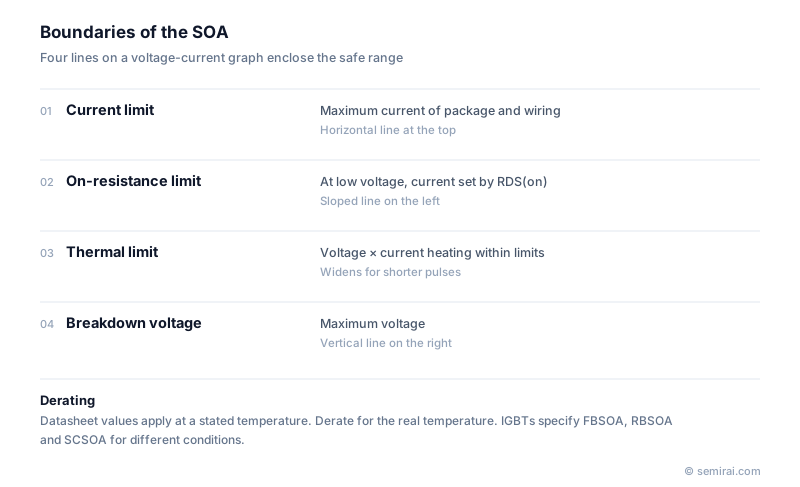
Reading the SOA graph
Several limits make up the boundary. At low voltage, a sloped line shows the current set by the on-resistance. Across the top is the maximum current rating, often limited by the package and bonding. On the right is the maximum voltage, the breakdown rating. Between them, diagonal lines show the thermal limit: the power the device can dissipate before the junction gets too hot. Short pulses do not give the chip time to heat fully, so their lines enclose a larger area. Bipolar transistors add a further limit for second breakdown, in which current crowds into a hot spot.
Datasheet SOA curves are normally given at a case temperature of 25 °C, which is rarely true in a real system. Designers derate the curves for the actual case temperature and check that every operating point, including transients, stays inside.
SOA types and linear-mode operation
For IGBTs, several SOAs are specified for different conditions: the forward-bias SOA (FBSOA) for the on state and turn-on, the reverse-bias SOA (RBSOA) for turn-off, when high voltage and high current coexist, and the short-circuit SOA (SCSOA), which defines how long the device can survive a short circuit.
Modern high-density power MOSFETs can have a narrower SOA in linear operation than older designs. When voltage and current are both high, a region that heats up can conduct more current, heat further and run away locally; this is known as the Spirito effect. Circuits that deliberately run MOSFETs in the linear region, such as inrush-current limiters, hot-swap controllers and electronic loads, must check SOA with particular care.
Japanese companies involved
- Toshiba Electronic Devices & Storage and ROHM publish SOA curves and derating guidance for their power MOSFETs and IGBTs.
- Toshiba Electronic Devices & Storage · Power MOSFETs, IGBTs and discrete semiconductors
- ROHM · SiC and silicon power devices, analog ICs
FAQ
Why does the SOA get larger for shorter pulses?
Heat takes time to flow from the junction into the package. In a very short pulse the chip's own thermal capacitance absorbs the energy before the temperature reaches its limit, so a higher power can be tolerated than in continuous operation.
Is a device inside the SOA always safe?
Only if the SOA has been derated for the real case temperature and the other ratings, such as maximum junction temperature, gate voltage and avalanche energy, are also respected. The SOA graph is one of several limits that must all be met.
Related pages
- Power Semiconductor
- IGBT (Insulated Gate Bipolar Transistor)
- Breakdown Voltage
- Avalanche Capability (Avalanche Energy)
- Trench MOSFET
- Junction Temperature / Thermal Resistance
- Double Pulse Test
- Power semiconductor manufacturing equipment
- Advantest EXAVIS
- Advantest MT100 / MT200
- Hitachi High-Tech M-600 / 6000 series
Sources
Last updated: November 2, 2026