Reaction Byproduct
A reaction byproduct is a substance formed alongside the intended reaction in the chemistry of etching or chemical vapour deposition (CVD). In etching it is the compound of the removed film with the process gas, such as SiCl₄ when silicon is etched with chlorine or SiF₄ when it is etched with fluorine. In CVD it is what remains after the precursors react, such as hydrogen chloride or ammonium chloride.
Also called: byproduct, etch byproduct, reaction product
Diagram
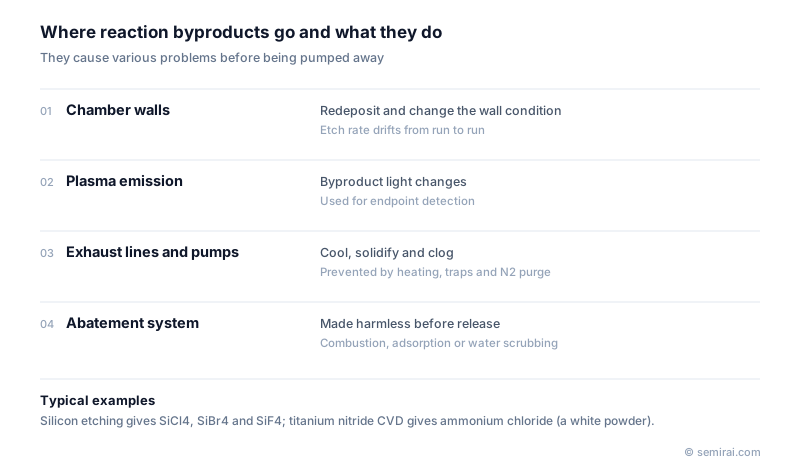
Byproducts in the etch chamber
Dry etching depends on byproducts being volatile so that they leave as gas and are pumped away quickly. This is why etch gases are chosen to form volatile compounds with the material being removed. Byproducts with low volatility redeposit on the chamber walls and on the wafer, changing the pattern shape and slowly altering the wall condition, so that the etch rate drifts from wafer to wafer.
Byproducts are also useful. Their light emission in the plasma changes when the film is cleared, and monitoring that change is a standard way to detect the etch endpoint.
Byproducts in exhaust lines and abatement
When gaseous byproducts cool in the exhaust line, they can condense into solids that clog pipes and damage vacuum pumps. A well-known case is CVD of titanium nitride from titanium tetrachloride and ammonia, which leaves white ammonium chloride powder in the foreline.
Countermeasures include heating the exhaust lines, placing traps to catch solids, and purging pumps with nitrogen. At the end of the line, abatement systems treat the exhaust by combustion, adsorption or water scrubbing before it is released.
Japanese companies involved
- Ebara makes dry vacuum pumps and exhaust gas abatement systems that must cope with etch and CVD byproducts.
- Kanken Techno makes exhaust gas abatement systems (scrubbers) that treat process exhaust from semiconductor fabs.
- Ebara · CMP systems, dry vacuum pumps and exhaust treatment
- Kanken Techno · Exhaust gas abatement systems (scrubbers)
FAQ
Why must etch byproducts be volatile?
If the removed material does not leave as a gas, it redeposits on the chamber walls and on the wafer. Redeposited material changes the pattern shape and the wall condition, which shifts etch rates. Choosing a gas that forms a volatile compound is a basic rule of etch chemistry, and it is one reason copper is hard to plasma-etch.
How are chamber walls kept in a stable condition?
Fabs run periodic plasma cleaning steps to remove deposits, then season the chamber with dummy wafers so the walls return to a reproducible state. Chamber condition is tracked through signals such as emission spectra and bias voltage.
Related pages
Sources
Last updated: November 13, 2026