II-VI Compound Semiconductor
A II-VI compound semiconductor combines zinc, cadmium or mercury (group 12) with sulphur, selenium, tellurium or oxygen (group 16). Examples are ZnS, ZnSe, CdS, CdTe, ZnO and HgCdTe. Their bandgaps span a very wide range, which makes them useful mainly for detecting and converting light.
Also called: II-VI semiconductor, group 12-16 semiconductor, ZnS, CdS, CdTe, HgCdTe
Diagram
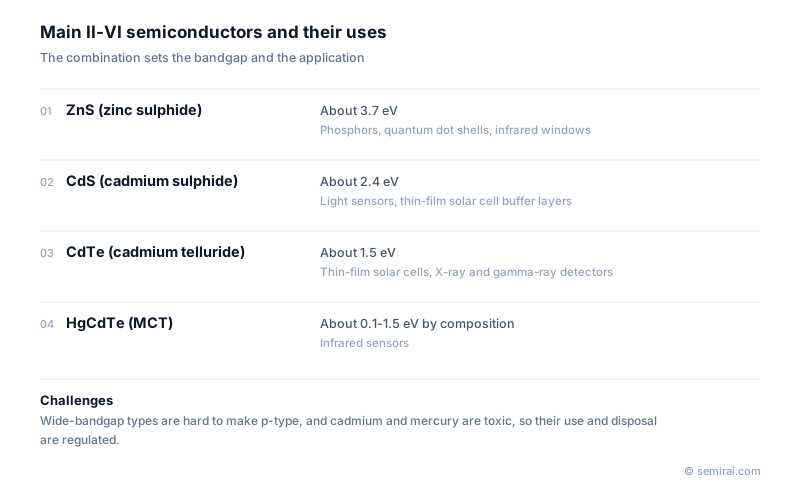
Why the bandgap range matters
The bonds in II-VI crystals are more ionic than those in III-V materials such as GaAs. Depending on the combination of elements, the bandgap runs from close to zero in mercury-rich HgCdTe to about 3.7 eV in ZnS. By choosing the composition, engineers can place the absorption edge almost anywhere from the far infrared to the ultraviolet.
This range gives each material a clear role. CdTe, with a bandgap of about 1.5 eV, absorbs sunlight strongly and is used in thin-film solar cells, with a thin CdS buffer layer in some designs. HgCdTe, often called MCT, is the classic material for infrared detectors because its bandgap can be tuned by the Hg to Cd ratio. CdTe and CdZnTe are dense, heavy crystals that stop X-rays and gamma rays, so they are used in radiation detectors. CdSe and ZnS are used in quantum dots and phosphors, with ZnS often forming the outer shell.
Limits: doping and toxicity
Wide-bandgap II-VI materials are hard to make p-type. When acceptors are added, the crystal tends to form native defects that compensate them, so good p-n junctions are difficult. ZnSe was once a leading candidate for blue light emitters, but short device lifetimes and these doping problems meant GaN took that role instead.
Cadmium and mercury are highly toxic, so their use and disposal are regulated in many countries. In display quantum dots, cadmium-free materials such as InP are increasingly used in place of CdSe.
Japanese companies involved
- JX Advanced Metals produces high-purity metals and compound semiconductor crystals, including CdTe-based crystals used for radiation detector substrates.
- Hamamatsu Photonics makes infrared detectors, including HgCdTe (MCT) photoconductive detectors, alongside its many other photonic sensors.
- JX Advanced Metals · Sputtering targets and high-purity metals
- Hamamatsu Photonics · Failure analysis, process monitoring and static elimination equipment
FAQ
How do II-VI and III-V semiconductors differ?
III-V materials pair group 13 elements such as gallium or indium with group 15 elements such as arsenic, phosphorus or nitrogen, and they dominate transistors and LEDs. II-VI materials pair group 12 and group 16 elements. Their more ionic bonds make p-type doping harder, so they are used mostly on the light-receiving side: detectors and solar cells.
Why are they called II-VI?
In the older numbering of the periodic table, zinc and cadmium belonged to group IIB and sulphur, selenium and tellurium to group VIB. The current IUPAC numbering places them in groups 12 and 16, but the old name has stayed in use.
Related pages
- Compound Semiconductor
- Gallium Arsenide (GaAs)
- Indium Phosphide (InP)
- Band Gap
- Solar Cell (Photovoltaic Cell)
- Photodiode
- Light-Emitting Diode (LED)
- Zincblende Structure
- Compound semiconductor wafers
- Compound semiconductor equipment
- Canon ANELVA EC8100
- HORIBA PLATO-MicroScan
- Resonac InP epitaxial wafers
- SAMCO RIE-400iPC
Sources
Last updated: November 13, 2026