Super Junction MOSFET
A super junction (SJ) MOSFET is a power MOSFET whose drift layer consists of alternating p-type and n-type columns, or pillars. In the off state the pillars deplete each other and the electric field becomes nearly uniform, which lets a silicon device go beyond the usual trade-off between breakdown voltage and on-resistance.
Also called: SJ MOSFET, superjunction
Diagram
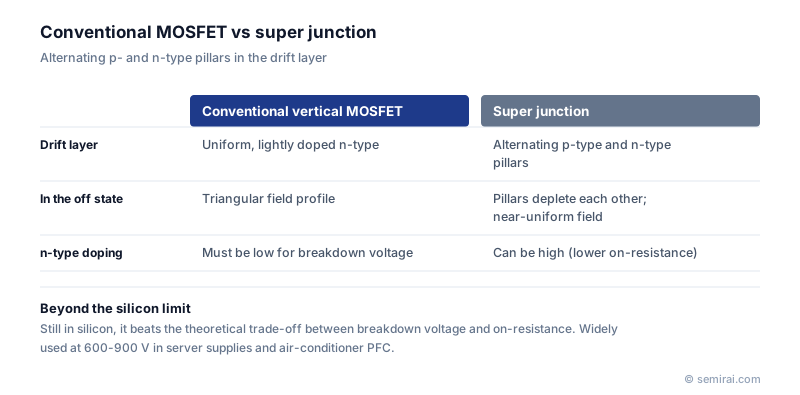
How the super junction works
In a conventional vertical MOSFET, a higher voltage rating requires a more lightly doped drift layer, and that directly raises on-resistance. This relationship is known as the silicon limit. In a super junction the charge in each n-pillar is balanced by the charge in the neighbouring p-pillars. Under reverse voltage they deplete sideways, so the field spreads evenly through the drift layer instead of peaking at the top.
Because the depletion no longer depends on the n-pillar being lightly doped, the n-pillars can be doped much more heavily and still hold the voltage. The on-resistance at the same rating drops to a fraction of that of a conventional device. The concept was developed in the 1990s and has been in production since the late 1990s.
Why it is hard to make
There are two main ways to form the pillars. One etches deep trenches and refills them by epitaxial growth. The other repeats epitaxy and ion implantation many times to build the pillars up layer by layer (multi-epitaxy). Both add many process steps and cost.
The p and n charge must be balanced precisely: even a small imbalance causes the breakdown voltage to fall quickly. Control of doping concentration and pillar width therefore has a direct effect on yield.
Where SJ MOSFETs are used
SJ MOSFETs are used mainly at 600 to 900 V, in server and telecom power supplies, solar power conditioners, chargers and the power factor correction (PFC) stages of air conditioners and other appliances. This voltage range overlaps with SiC and GaN, and the choice is made on cost and performance.
Japanese companies involved
- Fuji Electric and Toshiba Electronic Devices & Storage make super junction MOSFETs for power supplies and industrial equipment.
- Toshiba Electronic Devices & Storage · Power MOSFETs, IGBTs and discrete semiconductors
- Fuji Electric (power semiconductors) · IGBT modules and SiC power devices
FAQ
When is an SJ MOSFET chosen over a SiC MOSFET?
SJ MOSFETs are silicon devices, cheaper and very mature, so they suit applications where the switching frequency is moderate. SiC wins where low switching loss, high temperature or high frequency justify the higher price.
What is a weakness of SJ MOSFETs?
Their body diode tends to have a large reverse-recovery charge, which can cause loss and even failure in bridge circuits that use the diode for freewheeling. Fast-recovery versions with lifetime control are made for such circuits.
Related pages
- MOSFET (Metal-Oxide-Semiconductor Field-Effect Transistor)
- Breakdown Voltage
- Power Semiconductor
- Trench MOSFET
- Epitaxy (Epitaxial Growth)
- SiC MOSFET (Silicon Carbide MOSFET)
- Wide Bandgap Semiconductor (WBG)
- Body Diode
- Power semiconductor manufacturing equipment
- Advantest EXAVIS
- Advantest MT100 / MT200
- Hitachi High-Tech M-600 / 6000 series
Sources
Last updated: November 2, 2026