Process Control
Process control in semiconductor manufacturing is the set of methods and systems that measure the result of each process step, watch for drift and feed corrections back or forward so that wafers stay on target. It links metrology, statistical monitoring, equipment data and yield results into one loop that runs continuously across the fab.
Also called: fab process control, process monitoring and control
Diagram
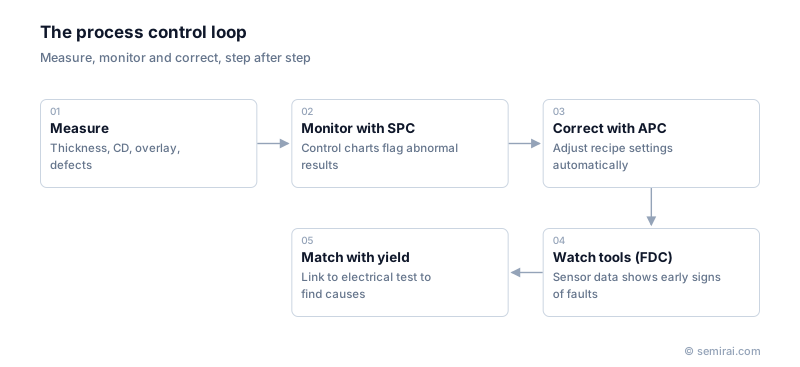
The building blocks
The loop starts with metrology: film thickness, critical dimension (CD), overlay and defect counts measured on sample wafers. Statistical process control (SPC) plots these numbers on control charts and flags points or trends that fall outside the normal range of the process. Advanced process control (APC) then adjusts recipe settings automatically, most often through run-to-run control, which corrects the next wafer or lot based on the last result.
Fault detection and classification (FDC) works on the equipment side. It reads sensor traces from each tool, such as gas flow, pressure, temperature and RF power, and stops or flags a tool when the traces depart from their usual shape, often before any bad wafer reaches metrology.
Feedback, feedforward and virtual metrology
Feedback control uses the result of a step to correct the same step on the next wafer. Feedforward control uses a measurement from an earlier step to set the conditions of a later one. A typical example is measuring a deposited film and then setting the polishing time and pressure in chemical mechanical planarization (CMP) so that the remaining thickness lands on target.
Measuring every wafer is too slow and expensive, so fabs also use virtual metrology: statistical or machine learning models that predict a wafer's result from the tool's process data. Predictions fill the gaps between real measurements and let the fab watch every wafer rather than a sample.
Why it matters
Modern chips pass through hundreds of process steps, and small shifts add up. Process control is what keeps those shifts from turning into lost yield or reliability problems. The final link in the loop is yield analysis, which ties electrical test results back to process and tool data to find root causes.
Japanese companies involved
- Hitachi High-Tech supplies CD-SEM and defect inspection and review systems whose measurements feed process control loops in many fabs.
- Yokogawa Electric provides factory software, including manufacturing execution and equipment communication systems, used to collect and act on fab data.
- Hitachi High-Tech · CD-SEM metrology, defect inspection and etch systems
- Yokogawa Electric · Fab software: MES, equipment communication and cell control
FAQ
Is process control the same as quality control?
Not exactly. Quality control decides whether finished output meets specification. Process control acts earlier: it keeps the process itself stable and centred so that out-of-specification wafers are not made in the first place.
What is the difference between FDC and SPC?
FDC watches equipment sensor data in real time while a wafer is being processed. SPC watches measured wafer results after processing. A fab uses both: FDC catches tool faults quickly, and SPC catches slower drifts in the product itself.
Related pages
Sources
Last updated: November 2, 2026