TEOS (Tetraethyl Orthosilicate)
TEOS (tetraethyl orthosilicate, Si(OC₂H₅)₄) is a liquid precursor widely used to deposit silicon dioxide (SiO₂) films by chemical vapour deposition (CVD). It is vaporised, carried into the chamber and decomposed by heat, plasma or ozone, giving oxide films that cover steps more evenly than oxide made from silane.
Also called: tetraethoxysilane, Si(OC2H5)4
Diagram
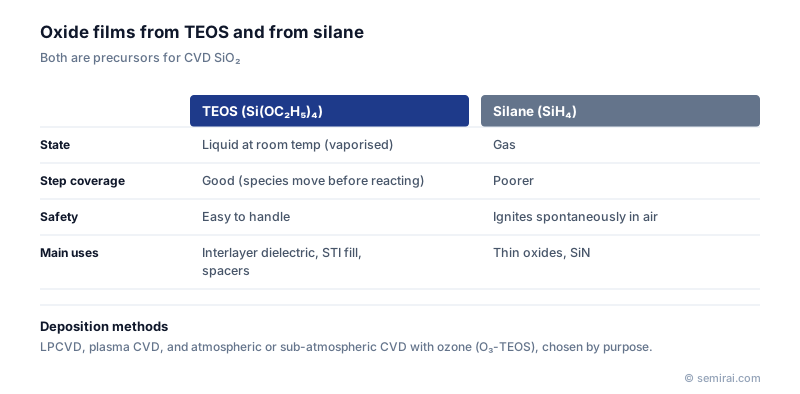
Why TEOS is used instead of silane
Silane (SiH₄) is a gas that ignites spontaneously in air, and oxide deposited from it tends to build up on the tops of features more than on the side walls and bottoms. TEOS is a liquid at room temperature that is easier to handle. Its reaction intermediates move across the surface before they react, so the film follows the shape of trenches and steps more closely. This conformality is the main reason TEOS oxide is used for interlayer dielectrics, trench filling and spacers.
The trade-off is that TEOS films can contain residual carbon, hydrogen and moisture, and their stress depends on the deposition conditions. These have to be controlled because they affect leakage, reliability and later process steps.
Deposition methods
Several CVD methods use TEOS. PE-TEOS, deposited by plasma-enhanced CVD at around 400 °C or below, gives fast deposition and is used for interlayer dielectrics between metal layers. O₃-TEOS, deposited at atmospheric or sub-atmospheric pressure (SACVD) by reacting TEOS with ozone, flows into narrow gaps and is used for gap fill. LPCVD TEOS, deposited at higher temperature in a furnace, gives uniform films for spacers and liners around the transistor gate.
In advanced processes some of these roles are taken by low-k dielectrics, flowable CVD and atomic layer deposition, but TEOS oxide remains a standard insulating film at both mature and leading-edge nodes.
Japanese companies involved
- Tosoh supplies high-purity CVD and ALD precursors for semiconductor manufacturing.
- Tosoh · Sputtering targets, ALD/CVD precursors and quartz glass
FAQ
Is TEOS oxide the same as thermal oxide?
Both are silicon dioxide, but thermal oxide is grown by oxidising the silicon itself at high temperature and has a cleaner, denser structure with a better interface. TEOS oxide is deposited on top of any surface, including metal, so it is used where the silicon cannot be oxidised or a thick film is needed.
How is a liquid precursor delivered to the chamber?
TEOS is either evaporated by bubbling a carrier gas through the heated liquid or metered as a liquid into a vaporiser. Flow and temperature are controlled closely, because the vapour supply sets the deposition rate and film uniformity.
Related pages
- CVD (Chemical Vapour Deposition)
- PECVD (Plasma-Enhanced Chemical Vapour Deposition)
- Shallow Trench Isolation (STI)
- Low-k Dielectric
- Specialty Gas
- Oxide Film (Silicon Dioxide)
- BPSG / PSG (Borophosphosilicate Glass)
- Interlayer Dielectric (ILD)
- Specialty gases
- Daikin Industries HFC-32
- Daikin Industries PFC-14
- Daikin Industries PFC-C318
Sources
Last updated: November 12, 2026