DC Discharge (Glow Discharge)
A DC discharge is a plasma created by applying a direct-current voltage between two electrodes in a low-pressure gas, which ionises the gas. Semiconductor equipment uses the stable, softly glowing regime called a glow discharge, and its main application is DC sputtering of metal targets.
Also called: direct-current discharge, DC glow discharge
Diagram
How a glow discharge starts and sustains itself
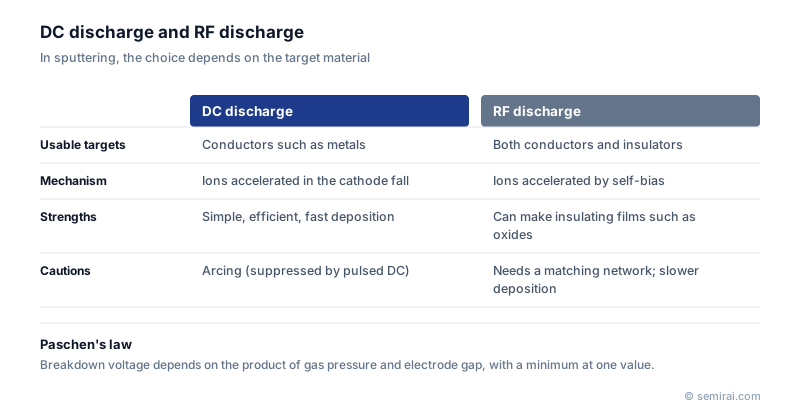
The voltage needed to start a discharge, the breakdown voltage, depends on the product of gas pressure and electrode gap and has a minimum at a certain value of that product. This is Paschen's law. At too low a pressure electrons make too few collisions to multiply; at too high a pressure they collide before gaining enough energy to ionise.
Once the discharge runs, most of the applied voltage drops across a thin region in front of the negative electrode, the cathode fall. Ions accelerated through it strike the cathode, sputtering atoms off its surface and releasing secondary electrons. Those electrons are accelerated back into the gas and create new ions, which keeps the discharge going.
Strengths and limits
A DC discharge is simple and efficient, which makes DC magnetron sputtering the workhorse for metal films. It cannot be used directly with insulating targets: positive charge from the arriving ions builds up on the surface, cancels the voltage that attracts the ions, and the discharge stops. Radio-frequency (RF) discharge is used for such targets.
Another concern is arcing, a sudden high-current discharge at one spot on the target, often where an insulating patch has formed. Arcs throw off droplets and particles. Pulsed DC supplies, which briefly reverse the voltage many thousands of times a second, discharge such patches and suppress arcing, especially in reactive sputtering.
Japanese companies involved
- ULVAC makes sputtering systems and vacuum equipment that use DC and RF discharges for thin-film deposition.
- ULVAC · Vacuum deposition (sputtering) equipment and vacuum pumps
FAQ
What is Paschen's law used for in equipment design?
Besides predicting where a discharge will ignite, it tells designers where one must not. Gaps between parts at different voltages are made small enough, or kept at pressures far from the Paschen minimum, so that unwanted parasitic discharges do not form inside the chamber.
Why can't DC discharge sputter insulating targets?
Each arriving ion leaves positive charge on the target. On a metal the charge flows away, but on an insulator it accumulates and soon cancels the voltage that pulls in the ions. With RF, the electrons that arrive in the other half of each cycle neutralise the charge, so the discharge continues.
Related pages
Sources
Last updated: November 13, 2026