Vacuum Evaporation (E-beam Evaporation)
Vacuum evaporation is a thin-film method that heats a material such as a metal in a vacuum until it evaporates or sublimes, so that the vapour condenses on the substrate as a film. Along with sputtering it is one of the main physical vapour deposition (PVD) methods and one of the oldest ways to make thin films.
Also called: thermal evaporation, electron-beam evaporation, e-beam evaporation
Diagram
Resistive and electron-beam evaporation
Evaporation methods differ in how they heat the source. Resistive evaporation passes current through a boat or filament that holds the material. Electron-beam evaporation focuses a beam of electrons on the material in a water-cooled crucible.
E-beam evaporation can melt high-melting-point metals and oxides, and because only the material itself gets hot, contamination from the crucible is low. It is the more common form in semiconductor work. The chamber is kept at high vacuum, so evaporated atoms fly straight to the substrate with almost no collisions.
Directional deposition and lift-off
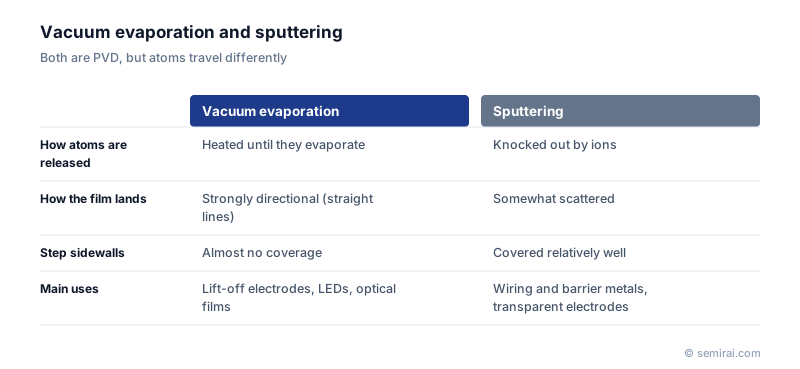
Because the atoms travel in straight lines, the film builds up strongly in one direction and hardly coats the sidewalls of steps; step coverage is poor. This is a weakness for coating trenches but a strength for lift-off patterning. A resist pattern is made first, metal is evaporated over everything, and the resist is dissolved, taking the metal on top of it away.
Lift-off with evaporated gold, titanium and platinum is widely used for electrodes of compound semiconductor transistors, LEDs and lasers. Evaporation is also used for optical coatings and organic light-emitting layers. For silicon interconnects that must coat the sides and bottoms of deep trenches, sputtering, CVD and ALD are used instead.
Japanese companies involved
- ULVAC makes vacuum evaporation equipment and electron-beam guns, as well as sputtering systems.
- Canon ANELVA builds vacuum deposition equipment, including sputtering and evaporation systems.
- ULVAC · Vacuum deposition (sputtering) equipment and vacuum pumps
- Showa Shinku · Vacuum evaporation, plasma cleaning and ion beam trimming equipment
- Shincron · Vacuum evaporation and sputtering systems
- Canon ANELVA · Sputtering and vacuum deposition equipment
FAQ
How is vacuum evaporation different from sputtering?
Evaporation boils atoms off a heated source; sputtering knocks them off a target with ions. Evaporated atoms travel in very straight lines, which suits lift-off. Sputtered atoms scatter somewhat, coat steps better and keep alloy compositions closer to the target, so sputtering is used for silicon barrier and wiring layers.
Why is evaporation well suited to lift-off?
Lift-off needs a break between the metal on the resist and the metal on the substrate. With straight-line deposition the resist sidewalls stay uncoated, so the solvent can reach the resist and the unwanted metal comes away cleanly. If the sidewalls were coated, the film would tear unpredictably.
Comparisons
Related pages
Sources
Last updated: November 13, 2026