Surface Tension
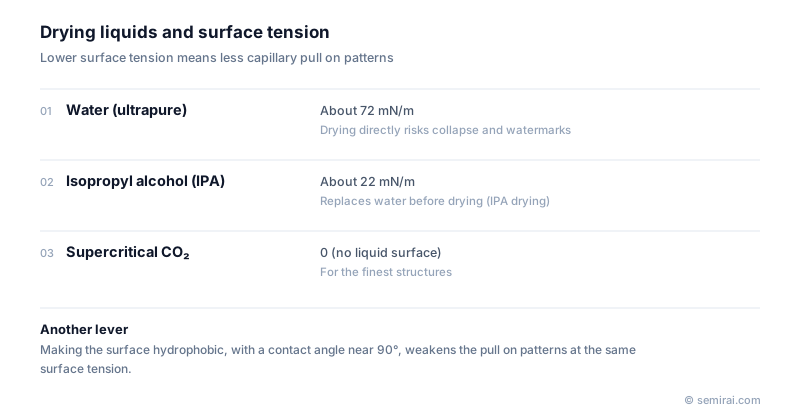
Surface tension is the force with which a liquid tends to minimise its surface area. Molecules inside a liquid attract each other, so those at the surface are pulled inward, which is why droplets become round. At room temperature water has about 72 mN/m and isopropyl alcohol (IPA) about 22 mN/m.
Also called: capillary force, pattern collapse
Diagram
Surface tension and pattern collapse
In wafer cleaning and drying, surface tension is the main cause of pattern collapse. When liquid trapped between fine features evaporates, the liquid surface pulls on the sidewalls through capillary force, and tall, narrow structures can bend, collapse or stick together.
The force is proportional to surface tension and grows as the gap between features shrinks. Replacing water with lower-surface-tension IPA before drying is therefore standard practice. Going from about 72 to about 22 mN/m cuts the force on the same structure to roughly one third.
Other countermeasures and roles
For still finer structures, the surface can be treated to make it hydrophobic, bringing the contact angle close to 90°, which weakens the capillary pull because it depends on the cosine of that angle. The most demanding cases use supercritical carbon dioxide drying, in which there is no liquid surface and therefore no surface tension.
Surface tension also drives Marangoni drying, where a gradient in surface tension pulls water off the wafer, and it governs how solder wets a pad and how melt convection behaves in Czochralski silicon crystal growth.
Japanese companies involved
- SCREEN Holdings and Tokyo Electron build single-wafer cleaning and drying systems that use IPA drying and other methods to prevent pattern collapse.
- SCREEN Holdings · Wafer cleaning, coat/develop and inspection equipment
- Tokyo Electron (TEL) · Coat/develop, etch and deposition equipment
FAQ
Why does lower surface tension reduce pattern collapse?
The capillary force pulling neighbouring features together is proportional to the liquid's surface tension. With IPA instead of water, the force on the same pattern drops to about one third, giving fragile structures more margin.
What is supercritical drying?
Carbon dioxide is taken above its critical temperature and pressure so that there is no distinction between liquid and gas. With no liquid surface there is no surface tension, so even very fragile patterns survive. The high-pressure equipment makes it more expensive than conventional drying.
Related pages
Sources
Last updated: November 12, 2026