Aerosol Cleaning (Cryogenic Aerosol)
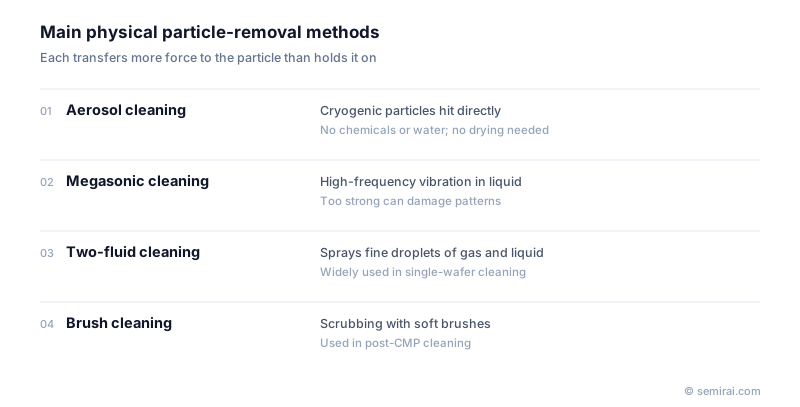
Aerosol cleaning is a dry cleaning method in which a gas such as argon or nitrogen is cooled to cryogenic temperature and expanded rapidly, forming fine solid or liquid particles (an aerosol) that are blown onto the wafer. Their impact knocks particles off the surface. Because of the cryogenic gas it is also called cryogenic cleaning.
Also called: cryogenic cleaning, cryo-aerosol cleaning
Diagram
How it removes small particles
As contaminant particles get smaller, the adhesion force holding them, mainly van der Waals force, becomes large compared with the drag a liquid flow can apply. That makes small particles hard to remove by rinsing.
In aerosol cleaning, frozen particles strike contaminants directly and transfer momentum, which can move even small particles. The cleaning particles warm up and turn back into gas almost immediately and are pumped away, so nothing is left on the wafer.
Strengths and limits
No chemical etching takes place, so surface films are not consumed, and no water is used, so there is no drying step and no risk of watermarks. This suits steps where wiring or gate films are exposed, moisture-sensitive materials, and the cleaning of masks and reticles.
If the impact is too strong it can damage fine patterns, so particle size and velocity must be controlled carefully. Like megasonic cleaning and two-fluid spray, it is one of the physical cleaning methods, and in practice it is combined with chemical cleaning.
Japanese companies involved
- Tokyo Electron and SCREEN Holdings build wafer cleaning systems that combine physical and chemical cleaning methods.
- Tokyo Electron (TEL) · Coat/develop, etch and deposition equipment
- SCREEN Holdings · Wafer cleaning, coat/develop and inspection equipment
FAQ
How does aerosol cleaning differ from megasonic cleaning?
Megasonic cleaning applies high-frequency sound to a liquid, and the vibration and flow in the liquid remove particles. Aerosol cleaning hits particles directly with frozen gas particles and uses no liquid. It is preferred where water must be avoided or a drying step is undesirable.
What happens to the frozen particles after impact?
They warm up immediately, return to gas and are exhausted. Unlike chemicals or water, they leave no residue, so the wafer does not need drying afterwards.
Related pages
Sources
Last updated: November 2, 2026