Zeta Potential
Zeta potential is a measure of the electrical charge on the surface of particles dispersed in a liquid. Strictly, it is the potential at the slipping plane, the outer edge of the liquid layer that moves with the particle. It indicates how strongly particles repel or attract each other, or a surface, through electrical forces.
Also called: electrokinetic potential, isoelectric point
Diagram
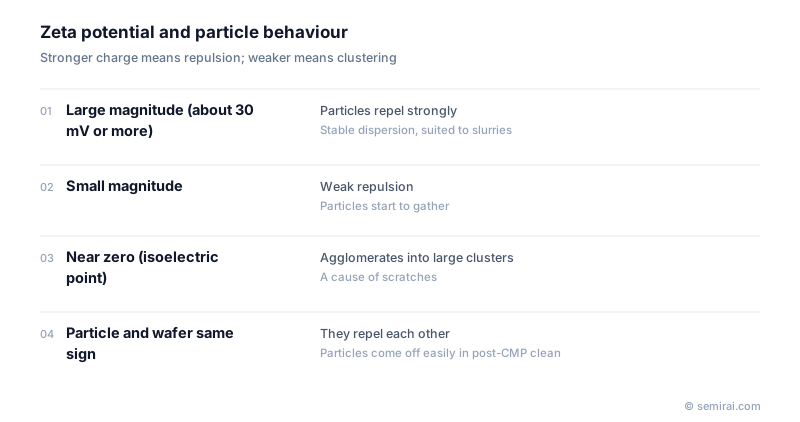
Dispersion of CMP slurries
Particle surfaces in liquid are usually charged positive or negative and surrounded by ions of the opposite charge. In a CMP slurry, if the particles all carry a strong charge of the same sign, commonly taken as an absolute value of about 30 mV or more, they repel each other and stay dispersed.
As the zeta potential approaches zero, repulsion weakens, particles cluster into agglomerates, and those agglomerates scratch the wafer. Zeta potential depends strongly on pH. The pH at which it becomes zero, the isoelectric point, differs by material: around pH 2–3 for silica and near neutral for ceria.
Role in cleaning and measurement
After CMP, abrasive particles left on the wafer are easier to remove if the cleaning solution's pH gives the particles and the wafer surface the same sign of charge. They then repel each other, particles detach more easily and do not redeposit. Slurry and cleaning chemistries are therefore designed from measured zeta potential versus pH curves.
Zeta potential is usually measured by electrophoretic light scattering, which uses light to track how fast particles move in an applied electric field.
Japanese companies involved
- Otsuka Electronics makes zeta potential and particle size analysers based on light scattering.
- Fujimi Incorporated and Resonac design CMP slurries whose dispersion stability depends on particle surface charge.
- Otsuka Electronics · Film thickness measurement and ellipsometers
- Fujimi Incorporated · CMP slurries and polishing materials
- Resonac · CMP slurries, packaging materials and SiC epitaxial wafers
FAQ
What is the isoelectric point?
It is the pH at which a particle's zeta potential is zero. Near it, electrical repulsion disappears and particles agglomerate easily. Because it differs by material, slurries and cleaning solutions are run at a pH well away from the isoelectric point of the particles involved.
Why are alkaline solutions common for post-CMP cleaning?
At high pH, silica particles and oxide surfaces are both negatively charged, so they repel each other. If particles and wafer had opposite charges, they would attract and stick, making the particles much harder to remove.
Related pages
Sources
Last updated: November 12, 2026