Supercritical Drying (Supercritical CO₂)
Supercritical drying removes the liquid left on a wafer after cleaning by taking it through the supercritical state, in which there is no distinction between liquid and gas, so the wafer dries without surface tension acting on it. In semiconductor manufacturing carbon dioxide (CO₂) is mainly used, to prevent tall, narrow patterns from collapsing during drying.
Also called: supercritical CO₂ drying, scCO₂ drying
Diagram
Why ordinary drying fails
In normal drying, as liquid between features evaporates, the boundary between liquid and air moves down between them. Surface tension at that boundary pulls neighbouring features together, and the taller and thinner they are, the more likely they are to bend, collapse or stick.
Replacing water with low-surface-tension isopropyl alcohol (IPA) before drying has long been the standard countermeasure. As features became narrower and aspect ratios higher, IPA alone could no longer prevent collapse in the most demanding structures.
How the process works
Carbon dioxide becomes supercritical above 31.1°C and 7.38 MPa. In this state it dissolves substances like a liquid, penetrates narrow gaps like a gas, and has no liquid surface.
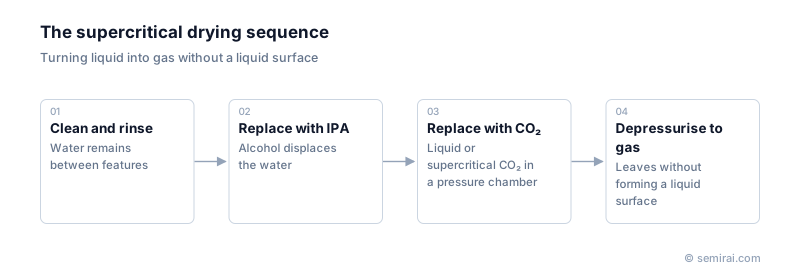
The water on the wafer is first replaced with IPA or a similar solvent. In a high-pressure chamber the solvent is then replaced with liquid or supercritical CO₂. Finally the pressure is lowered, and the CO₂ turns directly into gas without forming a liquid surface, so no capillary force acts on the pattern. The need for pressure-rated chambers, and the time and cost per wafer, are the main drawbacks.
Japanese companies involved
- Tokyo Electron and SCREEN Holdings build single-wafer cleaning and drying systems, the class of tool in which drying methods for collapse-prone patterns are developed and used.
- Tokyo Electron (TEL) · Coat/develop, etch and deposition equipment
- SCREEN Holdings · Wafer cleaning, coat/develop and inspection equipment
FAQ
Why don't patterns collapse in supercritical drying?
The force that collapses patterns is surface tension at the moving liquid-gas boundary. In the supercritical state that boundary does not exist, and lowering the pressure turns the fluid into gas directly, so no liquid surface ever passes between the features.
Why is carbon dioxide used?
Its critical point, 31.1°C and 7.38 MPa, is relatively easy to reach. Water would need about 374°C and 22 MPa, which is impractical for wafers. Carbon dioxide is also non-flammable, has low toxicity and can be recovered and reused after the process.
Related pages
Sources
Last updated: November 13, 2026