Binning
Binning is the sorting of semiconductor chips into several categories, called bins, according to their test results. Bins separate not only good from bad parts but also failure types and performance levels such as maximum operating frequency or power. The name comes from the boxes into which early test handlers dropped tested parts.
Also called: chip sorting, speed binning
Diagram
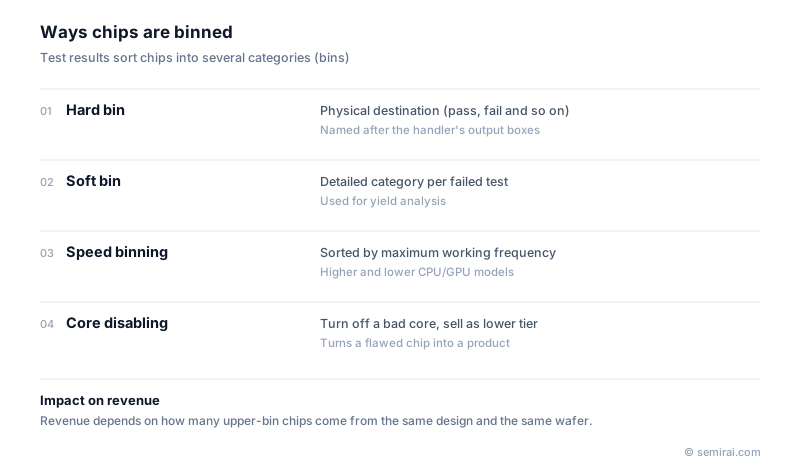
Hard bins and soft bins
Hard bins are a small number of coarse categories that match a physical destination: pass, fail, retest and so on. Soft bins record which test a chip failed and can run to dozens or hundreds of categories. Soft-bin counts are the basic data for yield analysis because they show which failure mechanisms dominate.
At wafer test, the bin of every die is stored in a wafer map, which later guides die picking at assembly and reveals spatial patterns such as edge failures or scratches.
Speed binning and core harvesting
Chips made from the same design in the same process still differ because of manufacturing variation: some run stably at higher clock frequencies or lower power than others. CPU and GPU makers measure each chip and sell the faster ones as higher-tier products and the slower ones as lower tiers. Chips with a defective core can also be sold by disabling that core and shipping the part as a model with fewer cores.
The share of chips landing in upper bins therefore affects revenue directly, since more valuable products come from the same wafer.
Setting bin limits
Loose limits let marginal parts escape to customers, so bin limits include a guard band that covers tester measurement error and variations in temperature and voltage. Binning is not limited to logic: LEDs are sorted by brightness and colour, and power devices by electrical characteristics, so that parts in one reel behave alike.
Japanese companies involved
- Advantest makes both test systems and test handlers; the handler places each tested device into the output tray or bin the tester assigns.
- Advantest · Automated test equipment (ATE) for SoC and memory
FAQ
What is the difference between a hard bin and a soft bin?
A hard bin is a coarse category tied to a physical outcome, such as a handler output tray or a wafer-map code for pass, fail or retest. A soft bin records the specific test that failed. One hard bin usually contains many soft bins, and engineers use soft-bin breakdowns to prioritise yield-improvement work.
Is a lower-bin processor a defective chip?
No. It passed all tests for the product it is sold as. It simply did not meet the higher frequency or power target of the top model, or it had a faulty unit that was disabled. It is guaranteed to its own specification, which includes its own guard band.
Related pages
Sources
Last updated: November 2, 2026