Isotropic and Anisotropic Etching
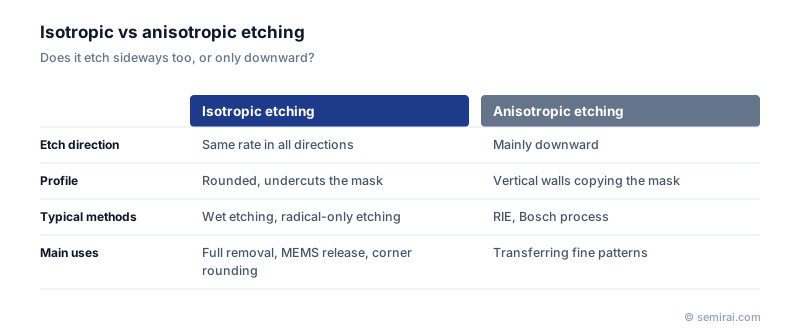
Isotropic etching removes material at the same rate in all directions, while anisotropic etching removes it strongly in one direction, usually downward, with almost no sideways etching. From a mask opening, an isotropic etch spreads under the mask edge, called undercut, and leaves a rounded profile. An anisotropic etch copies the mask shape straight down with vertical walls.
Also called: isotropic etching, anisotropic etching, directional etching
Diagram
Which methods give which result
Wet etching with chemicals and plasma etching driven only by radicals are isotropic, because reactive species reach the surface from every direction. In reactive ion etching (RIE) and similar dry etching, ions accelerated by the electric field arrive perpendicular to the wafer and bombard the bottom of the feature, while a protective film builds up on the sidewalls. The result is anisotropic.
There is an important exception. When silicon is etched with alkaline solutions such as potassium hydroxide (KOH), the etch rate depends strongly on the crystal plane, and the slow-etching (111) planes form facets. A wet etch can then produce well-defined shapes, such as sidewalls at 54.7° on a (100) wafer.
Where each type is used
Transferring fine patterns faithfully requires anisotropy, so most pattern etching in front-end processing is dry etching. Isotropic etching is used where sideways etching is harmless or wanted: removing whole films, rounding corners, releasing MEMS structures by etching away the layer beneath them, and steps that need very high selectivity. The ratio of lateral to vertical etching is used as a measure of how anisotropic a process is.
Japanese companies involved
- Tokyo Electron (TEL) makes dry etch systems for anisotropic pattern etching, and SCREEN Holdings makes wet processing equipment used for isotropic wet etching and cleaning.
- Tokyo Electron (TEL) · Coat/develop, etch and deposition equipment
- SCREEN Holdings · Wafer cleaning, coat/develop and inspection equipment
FAQ
What is undercut?
Undercut is etching that proceeds sideways beneath the mask, so material is removed inside the mask edge. In an isotropic etch the sideways distance is about equal to the depth, which ruins the dimensions of fine patterns. This is why anisotropic etching is used for small features.
Can wet etching be anisotropic?
Yes, for crystalline materials. Alkaline etchants such as KOH and TMAH etch the (111) planes of silicon very slowly, so the etch follows those planes and forms sloped facets or vertical walls depending on wafer orientation. This crystal-orientation-dependent etching is widely used to make MEMS grooves and cavities.
Comparisons
Related pages
Sources
Last updated: November 13, 2026