Fixed Abrasive Polishing
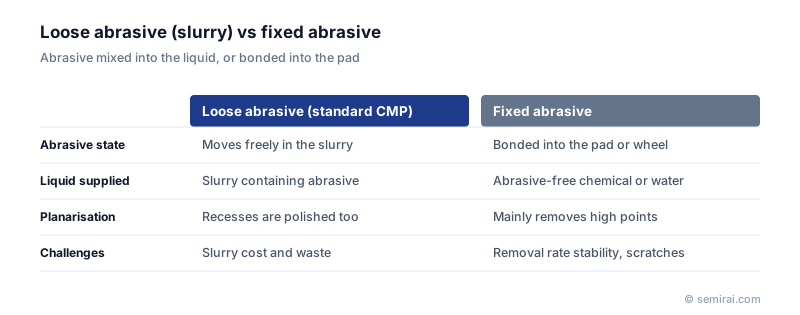
Fixed abrasive polishing is a method in which the hard abrasive grains are bonded into the pad or grinding wheel in advance, and the surface is polished while only an abrasive-free chemical solution or water is supplied. Conventional CMP instead uses loose abrasive: a slurry of dispersed particles flowing over a soft pad.
Also called: fixed-abrasive CMP, fixed abrasive pad
Diagram
Why it planarises efficiently
With loose abrasive, the soft pad reaches down into recessed areas and polishes both high and low regions. With fixed abrasive, the grains exposed on a relatively stiff pad mainly contact the high points, and recessed areas are polished much less. Step height is removed more efficiently, and dishing in the centre of wide patterns is smaller.
Because no large volume of slurry is needed, waste and consumable cost can also be reduced.
Uses and challenges
In semiconductor manufacturing, pads with fixed ceria abrasive have been used for oxide CMP in shallow trench isolation (STI). The challenges are that the exposure of abrasive on the pad surface changes with use, making removal rate less stable, and that hard fixed grains scratch the wafer more easily.
In a broader sense, back-grinding wheels used to thin wafers and diamond wire saws used to slice ingots are also fixed-abrasive machining.
Japanese companies involved
- Ebara builds CMP systems, the platform on which both slurry-based and fixed-abrasive polishing processes are run.
- DISCO makes grinding wheels and grinders, a fixed-abrasive process used for wafer thinning.
FAQ
What is the difference between fixed and loose abrasive?
Loose abrasive is dispersed in a slurry that flows during polishing; standard CMP works this way. Fixed abrasive is bonded into the pad or wheel, and only abrasive-free liquid is supplied. Fixed abrasive planarises more efficiently but tends to have less stable removal rate and more scratching.
Why does fixed abrasive reduce dishing?
Dishing happens when a soft pad sags into wide recessed features and keeps polishing their centre. With fixed abrasive on a stiffer pad, the grains mainly hit raised areas and hardly reach the recesses, so recessed regions are not polished further.
Related pages
Sources
Last updated: November 2, 2026