Stepper
A stepper is a reduction projection exposure tool that images the reticle pattern through a reduction lens onto one field, or shot, on the wafer, then moves the wafer by a fixed step and repeats the exposure until the wafer is covered. This step-and-repeat method became the mainstay of lithography from the 1980s.
Also called: reduction projection exposure tool, step-and-repeat exposure system
Diagram
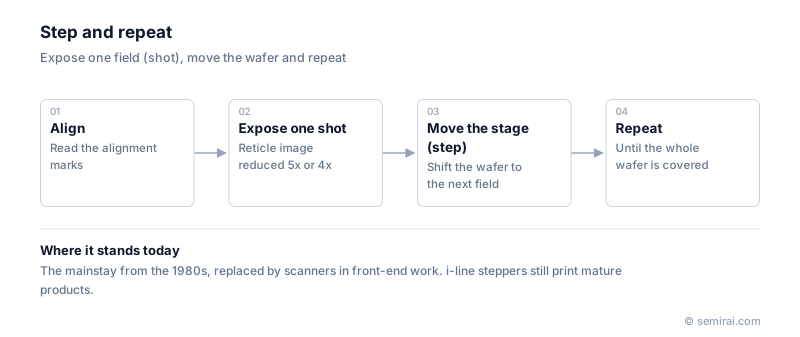
How a stepper works
The wafer stage moves to a field, the tool reads alignment marks to register the new layer to the layers already printed, and the whole field is exposed at once while the stage is stationary. The stage then steps to the next field. Reduction ratios of 5x and 4x are common, so the reticle pattern is larger than on the wafer, which relaxes reticle accuracy.
Steppers have used mercury-lamp g-line and i-line light and excimer lasers. Because the whole field is imaged at once, the lens must be corrected over the full field, which limits field size as resolution rises.
Stepper vs scanner
Scanners, introduced in the 1990s, expose the field through a narrow slit while the reticle and wafer move in sync. The lens only needs to be perfect over the slit, so scanners achieve larger fields and better imaging, and they replaced steppers for critical front-end layers.
Steppers remain widely used where resolution needs are modest. i-line steppers print non-critical layers in mature fabs, and are used in MEMS, power devices, LEDs and compound semiconductors, and in advanced packaging to pattern redistribution layers and bumps on wafers and panels.
Japanese companies involved
- Nikon introduced its first stepper in 1980 and, together with Canon, became one of the leading stepper makers during the 1980s and 1990s.
- Canon sells i-line steppers for front-end use and for advanced packaging, and Nikon continues to make i-line steppers alongside its scanners.
- ORC Manufacturing · UV exposure systems for package substrates and printed circuit boards
- Nikon · ArF, KrF and i-line lithography systems
- Canon · Lithography steppers and nanoimprint lithography
FAQ
Why is it called step-and-repeat?
The lens can only image an area much smaller than the wafer. The tool exposes one field, steps the wafer to the next position and repeats the same exposure, row by row, across the wafer.
What came before steppers?
Contact and proximity aligners, which placed the mask on or just above the wafer, and projection aligners that imaged the whole wafer at 1:1 with mirrors. Reduction steppers improved resolution and avoided mask damage from contact.
Are steppers still sold?
Yes. i-line steppers are sold for mature front-end processes, specialty devices and advanced packaging, where their lower cost and adequate resolution make them a better fit than scanners.
Related pages
Sources
Lithography terms
- All lithography terms
- Stochastic Effects (EUV)
- Swelling
- TMAH (Tetramethylammonium Hydroxide)
- EUV vs DUV lithography: what is the difference?
- High-NA EUV vs standard EUV: what is the difference?
- Single patterning vs multi-patterning: what is the difference?
- Chemically amplified resist vs metal oxide resist: what is the difference?
Last updated: November 1, 2026