Tungsten Hexafluoride (WF6)
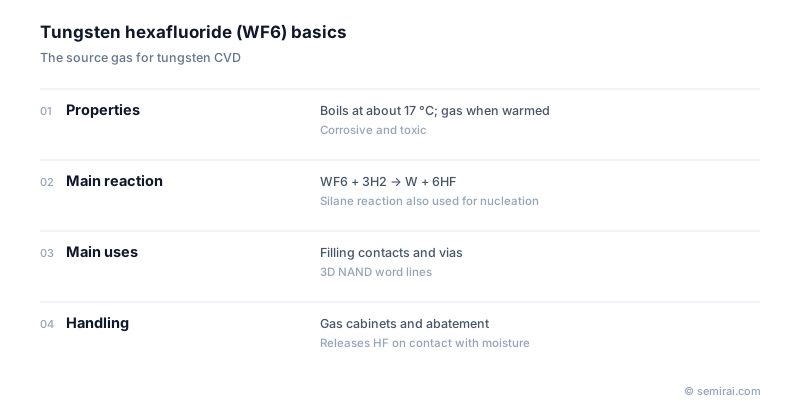
Tungsten hexafluoride (WF6) is a compound of one tungsten atom bonded to six fluorine atoms, used as the source gas for depositing tungsten films by chemical vapour deposition (CVD). It is a liquid near room temperature, but its boiling point is only about 17 °C, so slight warming turns it into a gas that can be fed to the process tool.
Also called: WF6
Diagram
How tungsten CVD works
WF6 is passed over a heated wafer together with hydrogen (H2) or silane (SiH4). The reaction leaves solid tungsten on the surface and carries the fluorine away as hydrogen fluoride or silicon fluorides. The main bulk reaction is WF6 + 3H2 → W + 6HF.
Tungsten CVD can fill narrow, deep holes evenly with metal. For that reason it has long been used to fill contacts, which connect transistors to the wiring, and vias, which connect wiring layers. In 3D NAND, the word lines that act as gate electrodes for the stacked memory cells are also made of tungsten, which has made 3D NAND a large user of WF6.
Handling and fluorine issues
WF6 is corrosive and toxic. It reacts with moisture in the air to release hydrogen fluoride (HF). It is therefore kept in gas cabinets with leak detection, piping is kept completely dry, and exhaust from the tools passes through abatement systems.
Fluorine left in the film or at the interface can attack the layers underneath. A barrier film such as titanium nitride is deposited first to protect them, and fluorine-free tungsten precursors are being researched for the most sensitive structures.
Japanese companies involved
- Kanto Denka Kogyo makes fluorine-based specialty gases for semiconductor manufacturing, including tungsten hexafluoride.
- Kanto Denka Kogyo · Fluorine-based specialty gases
FAQ
Why is tungsten deposited in two steps?
Tungsten does not start growing evenly on every surface. A thin nucleation layer is first formed using the silane reaction, which starts growth uniformly on the barrier film. The bulk fill is then done with the hydrogen reduction reaction, which gives lower resistance and good filling of deep features.
What safety measures are used for WF6?
Cylinders sit in gas cabinets with leak detectors and automatic shut-off valves. Lines are purged and dried before use because any moisture produces HF. Process exhaust is treated in abatement systems before release, and staff work under strict procedures for cylinder changes.
Related pages
Sources
Last updated: November 13, 2026