DC-DC Converter
A DC-DC converter is a circuit that changes one DC voltage into another. Semiconductor switches turn on and off at high speed while inductors and capacitors store and release energy, so the output can be stepped down or stepped up with high efficiency.
Also called: switching regulator, buck converter, boost converter
Diagram
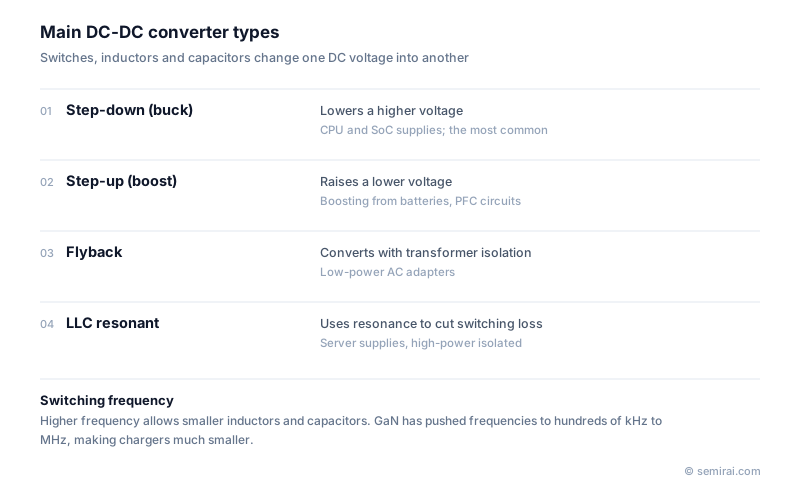
Main topologies
The three basic non-isolated topologies are the buck converter, which steps voltage down, the boost converter, which steps it up, and the buck-boost converter, which can do both. The buck is by far the most common: it powers processors, memory and nearly every chip on a circuit board.
When the input and output must be electrically isolated, a transformer is placed in the power path. Flyback converters are common in small AC adapters, forward converters in medium power, and LLC resonant or full-bridge converters in high-power supplies such as server power units.
Choosing the switching frequency
Switching frequency is the central design choice. A higher frequency allows smaller inductors and capacitors and higher power density, but adds switching loss and EMI. Gallium nitride (GaN) transistors loosened this limit by switching with much lower loss, making operation from hundreds of kilohertz into the megahertz range practical. This is the main reason laptop and phone chargers have become much smaller in recent years.
Where DC-DC converters are used
In an electric vehicle, a DC-DC converter steps the high-voltage traction battery down to the 12 V system for lights and electronics. In data centres, power is distributed at 48 V or similar and converted in several stages down to the sub-volt supply of each processor. In a smartphone, several converters distribute battery power to the processor, display and radio. Efficiency turns directly into less heat and longer battery life, so improvements in power devices show up here very clearly.
Japanese companies involved
- ROHM and Renesas Electronics make DC-DC converter controller and regulator ICs for automotive, industrial and consumer equipment.
- Murata Manufacturing makes DC-DC converter modules, along with the capacitors and inductors these circuits depend on.
- ROHM · SiC and silicon power devices, analog ICs
- Renesas Electronics · Microcontrollers, automotive SoCs, analog and power chips
- Murata Manufacturing · Capacitors, RF modules, SAW/BAW filters and MEMS sensors
FAQ
What is the difference between a DC-DC converter and an LDO?
An LDO is a linear regulator that drops excess voltage across a transistor as heat. It is simple and quiet but inefficient when the voltage difference is large. A switching DC-DC converter is efficient over a wide range but creates switching ripple and noise.
What is synchronous rectification?
In a buck converter, the diode that carries current while the main switch is off can be replaced by a second MOSFET that is turned on at the right moment. Its low on-resistance wastes much less power than a diode's forward voltage, so most modern low-voltage converters are synchronous.
Why do DC-DC converters cause noise?
The switches turn currents of several amperes on and off in nanoseconds. The resulting fast voltage and current edges radiate and conduct high-frequency noise. Careful board layout, filtering and sometimes an LDO after the converter are used to keep sensitive circuits clean.
Related pages
- Gallium Nitride (GaN)
- Switching Loss
- Power Semiconductor
- MOSFET (Metal-Oxide-Semiconductor Field-Effect Transistor)
- Wide Bandgap Semiconductor (WBG)
- Voltage Regulator
- Analog Circuit (Analog IC)
- Power semiconductor manufacturing equipment
- Advantest EXAVIS
- Advantest MT100 / MT200
- Hitachi High-Tech M-600 / 6000 series
Sources
Last updated: November 2, 2026