Voltage Regulator
A voltage regulator is a circuit, or an integrated circuit, that keeps its output voltage constant even when the input voltage or the load current changes. It turns the voltage of a battery or adapter into the stable supply that microcontrollers, sensors and other chips need, and is found in almost every electronic device.
Also called: LDO, linear regulator, switching regulator
Diagram
Linear regulators and LDOs
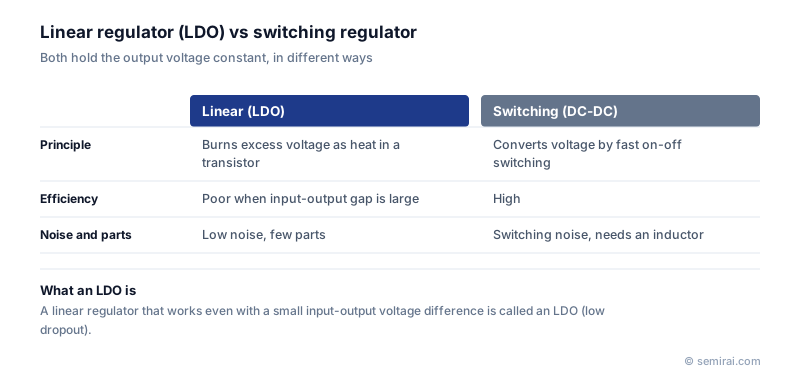
A linear regulator places a transistor between input and output and controls it like a variable resistor, dropping the excess voltage across it. It needs few parts, responds quickly and has very low output ripple and noise. The drawback is efficiency: the voltage difference multiplied by the load current is lost as heat, so a large difference wastes a lot of power.
A low-dropout (LDO) regulator is a linear regulator that keeps regulating even when the input is only slightly above the output. LDOs are widely used in battery-powered equipment and to supply noise-sensitive analog, sensor and radio-frequency circuits.
Switching regulators
A switching regulator turns a transistor on and off at high speed and smooths the result with an inductor and capacitors. Also called a DC-DC converter, it comes in step-down (buck), step-up (boost) and other forms. Efficiency often exceeds 90 percent, so switching regulators supply the high currents of processors and graphics chips. Their drawback is switching noise. A common arrangement is to step the voltage down efficiently with a switching regulator and then clean it with an LDO placed after it.
How regulators are specified
Line regulation describes how much the output changes when the input voltage changes; load regulation, how much it changes with load current. The power supply rejection ratio (PSRR) measures how well the regulator blocks ripple on its input from reaching the output, and is a key figure for LDOs feeding sensitive circuits. Dropout voltage, quiescent current and transient response complete the main specifications.
Japanese companies involved
- ROHM and Renesas Electronics make LDOs and switching regulator ICs for automotive, industrial and consumer equipment.
- ROHM · SiC and silicon power devices, analog ICs
- Renesas Electronics · Microcontrollers, automotive SoCs, analog and power chips
FAQ
When should I use an LDO rather than a switching regulator?
An LDO suits cases where the input-output difference and the current are small, or where low noise matters more than efficiency. When the voltage difference or the current is large, a switching regulator saves power and heat.
What does quiescent current mean for a regulator?
It is the current the regulator itself draws to operate, even with no load. In battery-powered devices that spend most of their time asleep, a regulator with very low quiescent current can matter more for battery life than its full-load efficiency.
Related pages
Sources
Last updated: November 2, 2026