Collimator (Collimated Sputtering)
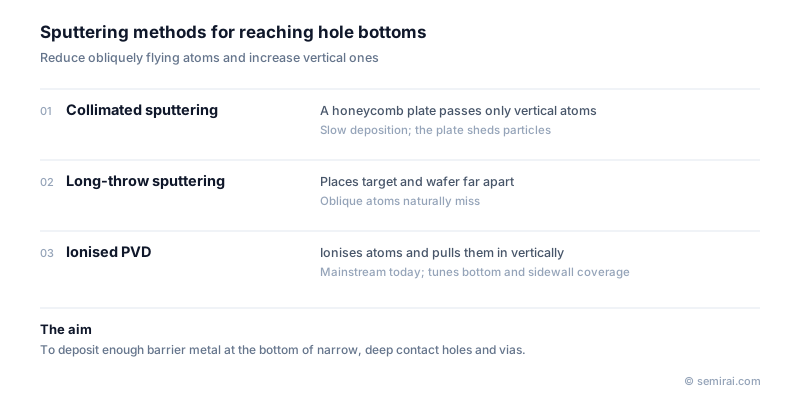
A collimator is a component that passes only particles or light travelling in a chosen direction. In collimated sputtering, a plate with a honeycomb of narrow channels sits between the target and the wafer and passes only atoms moving nearly perpendicular to the wafer, so more of them reach the bottom of narrow contact holes.
Also called: collimated sputtering, collimated PVD
Diagram
Why collimation helps
Atoms sputtered from a target leave in a wide range of directions. In a narrow, deep contact hole, atoms arriving at an angle land on the upper sidewalls and the rim, and very few reach the bottom. The film there, often a titanium or titanium nitride barrier, ends up too thin.
A collimator filters out the oblique atoms. The ones that pass travel almost straight down and land on the hole bottom, which improves bottom coverage. The technique was used in the 1990s as contact holes shrank and their aspect ratios rose.
Why it was replaced
The collimator walls catch most of the sputtered material, so the deposition rate falls sharply. The film that builds up on the collimator can also flake off and fall on wafers as particles, and the plate must be cleaned or replaced regularly.
Two methods took over. Long-throw sputtering increases the distance between target and wafer so that oblique atoms simply miss, giving a similar filtering effect without a plate. Ionised PVD ionises the sputtered atoms and draws them vertically onto the wafer with a bias voltage, which is more efficient and allows the bottom and sidewall coverage to be tuned. Ionised PVD is the mainstream approach today.
Outside deposition, the word also names parts that make light or X-rays parallel in optical and analytical instruments.
Japanese companies involved
- ULVAC · Vacuum deposition (sputtering) equipment and vacuum pumps
FAQ
How does a collimator improve bottom coverage?
It works as a directional filter. Only atoms whose path is close to the axis of the honeycomb channels pass through, so the flux reaching the wafer is concentrated near the vertical and can travel straight down narrow holes instead of hitting their upper walls.
What is the aspect ratio of a collimator?
It is the ratio of channel length to channel width. A higher ratio passes a narrower range of angles and gives better bottom coverage, but it also blocks more material and slows deposition, so collimators were chosen to match the aspect ratio of the holes being filled.
Related pages
Sources
Last updated: November 13, 2026