Magnetron Sputtering
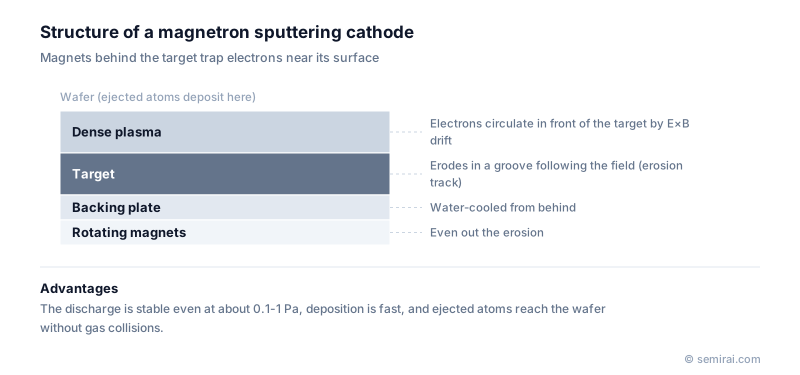
Magnetron sputtering is a sputtering method in which magnets placed behind the target create a magnetic field near its surface that traps electrons there. The trapped electrons ionise the gas much more efficiently, forming a dense plasma in front of the target. Nearly all sputtering tools used for chip wiring and barrier metals are of this type.
Also called: magnetron sputter deposition, DC magnetron, RF magnetron
Diagram
How the magnetic field helps
Where the electric and magnetic fields cross, electrons spiral around the magnetic field lines and drift along the target surface in a closed loop, a motion known as E×B drift. Because they cannot escape quickly, each electron collides with many more gas atoms and creates many more ions than it would without the magnets.
The result is a dense plasma just in front of the target. The discharge stays stable at low pressures of roughly 0.1-1 Pa, and the deposition rate is much higher than in sputtering without magnets. At low pressure the sputtered atoms reach the wafer with few gas collisions, which also improves film quality.
Weaknesses and variants
The plasma is densest where the magnetic field lines run parallel to the target surface, so the target erodes in a groove, the erosion track. This limits target utilisation and can make film thickness uneven. Rotating the magnet assembly moves the erosion track and evens out both.
Metals are sputtered with a DC supply, insulators with radio frequency (RF). Adding a reactive gas such as nitrogen gives reactive sputtering, used for titanium nitride and tantalum nitride. To reach the bottom of narrow holes, ionised PVD ionises a large share of the sputtered atoms and pulls them vertically onto the wafer with a bias voltage.
Japanese companies involved
- ULVAC makes magnetron sputtering systems for semiconductors, electronic components and displays.
- Canon ANELVA builds magnetron sputtering equipment, including systems for magnetic and metal thin films.
- ULVAC · Vacuum deposition (sputtering) equipment and vacuum pumps
- Canon ANELVA · Sputtering and vacuum deposition equipment
FAQ
Why does magnetron sputtering deposit faster?
The magnetic field keeps electrons close to the target, where they ionise many more gas atoms. The denser plasma sends more ions into the target per second, so more target atoms are ejected and the film grows faster.
What is high-power impulse magnetron sputtering (HiPIMS)?
HiPIMS applies very short, very high-power pulses to the magnetron. The peak plasma density is high enough to ionise a large fraction of the sputtered metal atoms, which can then be steered by a bias voltage to produce denser films and better coverage, at the cost of a lower average deposition rate.
Related pages
Sources
Last updated: November 13, 2026